Monday, January 4, 2016

A sad ending to the year

Naturally, I wish every reader of this blog a very happy, prosperous and satisfactory 2016. For those of us who are concerned with the future status of this country, this will be an important year though, for what it's worth, I still think the referendum will be in 2017. But the various players in the campaign are emerging and lining up. There will be many other things to blog about as well and I have a few projects lined up that will take up time. I do, however, intend to be a little more attentive to Your Freedom And Ours.


In that connection I must turn to the sadness that overwhelmed many of us who care about that concept in the last few days of 2015. A couple of days after Christmas I was told of the death of Leonid Finkelstein (Vladimirov), a man who was well known among those who fought against the Soviet Union and have, more recently, resumed that battle against the Putin regime.

I have known Leonid for many years, first as a friend of my father's, then as a remarkably lenient boss at the London office of Radio Liberty, where I had a summer job in my undergraduate years, and for a good long time as a close friend. In fact, if it had not been for Leonid, his wife Kira (a colleague of my mother's when they were working on the Oxford English-Russian Dictionary and a good friend of mine) and, above all, their cat, Billy, my doctoral thesis might not have been completed. At a crucial moment in its writing when I was desperate for time and space they asked me to spend two weeks in their house cat sitting. Those two weeks gave me the time and space to write the missing chapter without which the thesis could not stand up. Billycat, as he was known in my family, did not complain.

Leonid came to London in the summer of 1966 as part of a journalistic delegation and found a suitable moment when he could move away from the group, walk into a police station and ask for asylum. For Soviet citizens to do so in the mid-sixties was hazardous business as the Soviet authorities were capable of almost anything to prevent such events. There were cases of failed and successful kidnappings, traffic accidents and even mysterious illnesses, sometimes fatal. Attempts to return Leonid were made but he managed to evade them though his desire to live and work in England meant that he did not see his family again for a good many years.

Using the name Leonid Vladimirov (from his patronymic Vladimirovich) he worked as a broadcaster for Radio Liberty in London and in Munich and for the BBC Russian Service; he reported on British politics as well as led discussions and compiled programmes about British life; he wrote articles and two highly regarded books, The Russians and The Russian Space Bluff. As a science journalist in the USSR he was particularly well placed to reveal the truth behind that country's space programme.

In fact, it is hard to overestimate Leonid's contribution both to Western understanding of the Soviet Union and, perhaps more importantly, Russian understanding of Britain.

Even after his retirement from the BBC he contributed various programmes, such as this short talk about his imprisonment in Stalin's gulag (oh yes, he was, just like many millions of people). He attended various events and contributed to talks and discussions. I particularly remember a discussion we had at the Centre for Research into Post-Communist Economies (CRCE) in 2004 about Samizdat in the Soviet Union. Leonid was not on the panel but he might as well have been, considering the importance of his contribution. The paper was published. [Scroll down] Other people will have other examples.

In the last few years Leonid and I met at events in Pushkin House as well as CRCE and at demonstrations outside the Russian Consulate. Once again, we all had to join the fight for the freedom of Russia against its state.

Let me not forget chess - one of Leonid's crucial interests. If I happened to call his home to find out how he was after an operation or an illness, I could find him only to be told that he was suffering from an incurable disease - age - or, much more likely I found his wife, Kira, who told me that he was not at home as he was taking part in some chess tournament, possibly in London, possibly somewhere else, near or far. Don't believe me? Here is an interview on the Hamilton-Russell Chess Cup site.

Though I have seen Leonid more recently, my best last memory is from the year before last when my daughter and I took Leonid and Kira out to Ognisko Restaurant in Kensington to celebrate his 90th birthday. It was an extremely jolly evening during which we all had ferocious discussions about Russian literature about which we all disagreed. (No point in discussing Russian politics - we all agreed on that.) I do not have photos from that event but here are two of Leonid and Kira from another dinner in the Polish restaurant, Patio, in 2010:


Rest In Peace, Leonid Vladimirovich. 

Wednesday, December 30, 2015

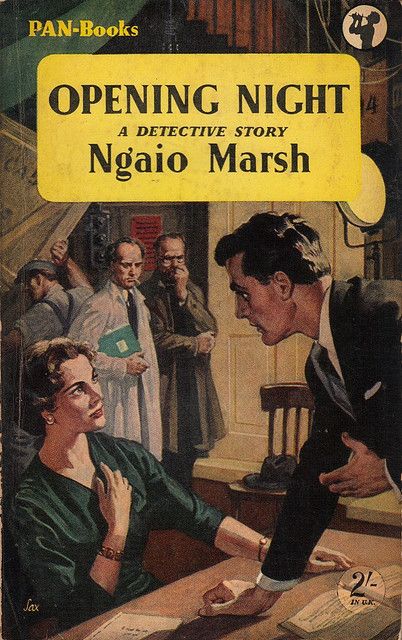
Tuesday Night Blogs: Ngaio Marsh and the Scottish Play

In Ngaio Marsh - Her Life in Crime Joanne Drayton wrote that Marsh had kept her life in compartments; theatre director, writer, life in New Zealand, life in Britain and Europe, private life with different people often in different countries. Occasionally these overlapped through dedication of books to people who might belong to another part of her life not the British literary scene, through the appearance of certain characters based on real ones, such as the egregious Lampreys but most often through Shakespeare whose plays are referred to or quoted in numerous novels while a number was produced by her in New Zealand, especially for the Canterbury College Drama Society.

Of the various plays it is Hamlet and Macbeth, particularly the latter, that are mentioned most often. The Scottish Play is central in two novels and is important in several for various reasons.

Marsh produced Macbeth at least twice, the first time immediately after the war at the CUCDS, advertising for demobbed soldiers to play various parts. The production was marred by the inadequate props, toy swords and Macbeth's papier mâché head on a stick in the last scene. This was corrected for the subsequent hugely successful tour but memories of the humiliating notices may well have been with Marsh when she was writing Light Thickens, her last novel and one of her best ones, which is about the perfect production of the play.

The same year, 1946, she wrote a book about what she considered to be the right way to tackle plays, particularly Shakespeare, A Play Toward: A Note On Play Production. The ideas she expressed in it, ones that crop up in her novels that are about theatrical productions, were not precisely new but, it seems, unknown among New Zealand critics.
Dramatic dialogue was not a series of speeches delivered by individual actors but a series of spoken movements, each with its own form and climax, carried out be a group of players.
In 1947 she wrote Final Curtain in which Troy paints the portrait of a great Shakespearian actor, Sir Henry Ancred, as Macbeth, one of his most successful parts. On her way to the Ancreds' mansion Troy reads the play again and finds herself quite shaken by it. That happens again when Sir Henry, during one of the sessions, recites a monologue from it. The completed portrait is supposed to be of an old actor looking back into his past and saying farewell to his part.

The Scottish play is quoted and discussed in a number of other novels. In Surfeit of Lampreys Alleyn meets a constable on the beat who starts talking about seeing and reading the play. His rather artless analysis of it puts his superior officer on the right track. In Colour Scheme, the great actor who is stranded in New Zealand while longing to be back in Britain to help the war effort, recites one of the great soliloquies at a concert. In the second New Zealand novel, Died in the Wool, Florence Ruback, the politician whose murder Alleyn is investigating, is compared to one of the Weird Sisters. Macbeth is quoted by P. E. Garbel in Spinsters in Jeopardy and by Jacko in Opening Night, the latter sending the hopeless Gail Gainsford into floods of hysterics, propelling Martyn Tarne onto the stage and triggering the final catastrophe. In Singing in the Shrouds Alleyn not only quotes Duncan on Cawdor, he also has an argument with the retired schoolmaster, Mr Merryman, about the relative merits of Macbeth and Hamlet on the one hand and Othello and The Duchess of Malfi on the other. The argument provides an important clue. On the other hand, a quotation about Lady Macbeth in Dead Water turns out to be of no significance - Mrs Barrimore (another splendid name with its reference to The Hound of the Baskervilles and the acting dynasty) turns out to be a very different person.

In 1962 Marsh mounted another highly successful production of Macbeth and in January 1982 she completed her last and, perhaps, most difficult novel, Light Thickens. She sent the typescript off on January 7 and died, aged 86, on February 18. The book takes place, once again, at the Dolphin theatre where Peregrine Jay directs what is described by the critics after the first night, the perfect Macbeth. The novel, as usual, deals with the many clashing personalities and intrigues that a theatre consists of and with the details of the casting, props, direction and success, which brings tragedy with it. There is a strong feeling that the tragedy is inevitable, the play being what it is though Alleyn himself refuses to deal with anything but the most human aspect of the crime.

There were problems with the novel, both in the writing of it with Marsh feeling ill and tired and with the subsequent editing. Apparently, the discussion about how to produce Macbeth was considerably longer in the typescript than in the edited novel. Indeed, a great deal of editing had to be done by Elizabeth Walter at Collins. Whether the fact that she could not refer back to the author was a help or a hindrance is not clear. The final product is excellent and a great credit to Dame Ngaio Marsh and her editor.


Tuesday, December 29, 2015

Post-festive message

Somehow I did not manage to get round to wishing all my readers a very merry Christmas though, obviously, I did do so at the back of my mind. I hope everyone did have a jolly or quiet Christmas, depending on what they wanted and are now relaxing in preparation to the next lot of good wishes at the end of this week. I am aware of my shortcomings in this blog through 2015 but hope to be able to deal with that in the days, weeks and months to come.

Tuesday, December 22, 2015

Tuesday Night Blogs: Ngaio Marsh and the naming of names

As part of this exercise, the results of which can be followed on Moira Redmond's splendid blog, I have been trying to re-read all the Marsh novels in order. Trying and failing with some of them, I have to admit, either because I find Morris dancing intolerably boring especially when it is linked to a description of an old-fashioned feudal village with an old-fashioned feudal lady of the manor (Off With His Head or Death of a Fool in the US) or because some of the novels are just too dull (for instance Swing, Brother, Swing).

I have now entered the post-war period, which produced some excellent novels (Clutch of Constables, Opening Night, When in Rome and Light Thickens are among my favourite Marsh books), some real duds (see above and add Last Ditch to that) and some ho-hum in between ones, one of which is Scales of Justice, the one I have reached.

Scales of Justice is one of the English village mysteries. I have not added them up but it does seem to me that Ngaio Marsh wrote more of them than Agatha Christie did. She certainly had more grand families and continued to have them after the war, when social mores and economic realities changed considerably. Christie knew that but she lived in England. Other writers like E. C. R. Lorac also knew that but she, too, lived in England. Marsh lived mostly in New Zealand and visited England. Her village mysteries were a little uncertain in tone even before the war and became very shaky after it.

To be fair, there are several references, not least by Alleyn, to the fact that the feudal family of Scales of Justice, the Lacklanders, have money and a life style that few can afford in the mid-fifties (the book was published in 1958). Apparently, they are and have always been known as lucky Lacklanders and the money comes from various spectacular sweepstake and racing winnings, none of which would have been taxed. At this point Josephine Tey, who was interested in horses and race meetings, would have shown the Lacklanders as discussing the horses they own and forthcoming events but Marsh does not.

It is the District Nurse who expounds most eloquently the joys of living in a feudal society and resents any suggestion that there might be a few problems underneath the happy and settled surface. (It is not at all clear, incidentally, the Marsh realized that the healthcare system had changed in Britain with the creation, for better or worse, of the NHS.) The reader is slightly disappointed to find at the end of the book that the District Nurse's attitude is that of the novelist's despite one or two tart comments by Alleyn. The outsider turns out to be the murderer, just as everyone had hoped and for whom only Inspector Fox feels any compassion; the shadows of past sins are not simply shortened but practically erased; and Nurse Kettle, like some latter-day Pippa, goes on her way reminding herself that God's in His Heaven and all is right with the part of the world she lives in.

Nurse Kettle! What a wonderful name, evocative of practically everything one knows about nursing and the behaviour of nurses. Then again, the name of the feudal family is Lacklander with an immediate link to English history, particularly to King John Lackland, except that they are lucky and he was not.

This brings me to my main theme, which ties in with a previous posting of mine, about Marsh's wonderful literary abilities: she chose the most evocative names for her characters. Partly, it has to be assumed, this came from her theatrical background with Shakespeare, other Elizabethan and Jacobean playwrights as well as seventeenth and eighteenth century comedies for an example.

She herself explained how she arrived at her hero's name: Alleyn after the great Elizabethan actor and founder of Dulwich College, her father's alma mater and Roderick because she had met somebody of that name during a visit to the Highlands of Scotland. When she thought of the woman Alleyn was to fall in love with, she wanted a very plain, worthy first name and an odd surname. She created Agatha Troy, who signed her pictures and was known by all those close to her, including her husband, by the surname, which has a forcefulness that goes well with her personality. Death in White Tie, said Marsh once, could have been called The Siege of Troy, although Alleyn does not use underhand Greek methods.

People who know Alleyn call him Rory and those who know his wife call her Troy but her cousin P. E. Garbel, a slightly confused but very likeable character in Spinsters in Jeopardy, thinks of them as cousins Roddy and Aggie, thus showing her own rather odd way of looking at the world.

There are many examples of the happy naming of names in Marsh's novels. What could be a more splendid name for an actor, playwright, director and theatre manager than Peregrine Jay (Death at the Dolphin and Light Thickens)? The Lampreys were presumably given that surname in order to produce the punning title, which then, sadly, had to be changed for the American audience to Death of a Peer.

Then there is the playwright Aubrey Mandrake in Death and the Dancing Footman, whose original name is Stanley Footling. Both of those are guaranteed to bring a smile to the reader's face. The squire of Pen Cuckoo, who rather fancies himself as a gay dog, has the eighteenth century name Jocelyn Jerningham, while his son goes by the far more sober Henry Jerningham (Overture to Death). The rector of Winston St Giles in the same novel and in Death and the Dancing Footman is Walter Copeland, a name that assures one of his High Church tendencies. His daughter, an actress, is a very modern Diana.

My favourite name is perhaps the doorman's in Opening Night. Fred Badger takes one right back to the rude mechanics of Midsummer Night's Dream.

I am rather fond of Marsh's theatre names as well. The Unicorn turns up in several novels if only in passing mention (there is, in fact, a children's theatre in London called the Unicorn); the Jupiter in the short story I Can Find My Way Out becomes the Vulcan by the time of Opening Night but that does not save it from having another murder; while the Dolphin (vaguely based on the Mermaid though most emphatically on the other side of the Thames) keeps its name and also has a second murder in it. There really is no escape from the Eumenides.

Wednesday, December 16, 2015

Tuesday Night Blogs: Ngaio Marsh, the occult and related matters

Well, yes, it is once again Wednesday as Tuesday evening went into discussions, dinner and .... well, more discussions. Still, the blog is happening.

Unlike Christie, Marsh did not seem to have any real interest in matters beyond the body. She could not, for instance, have written anything like the strange but weirdly attractive series of stories about Mr Harley Quin. Neither did she seem particularly interested in matters of religion. Or so it would appear. Peering into the novels one sees a slightly more complicated picture.


Occult, as such, is important in three novels, two about somewhat dotty but also very sinister cults, Death in Ecstasy and Spinsters in Jeopardy, and one in which some quite revolting activity grows out of one character's obsession with it, Surfeit of Lampreys.

Marsh, unlike, say, Margaret Millar in How Like An Angel, shows little interest in understanding those who join the two cults though she does have some sympathy for young people who, for whatever reason, have no moral compass to guide them through life and for older lonely ones who are easily exploited by fraudsters and drug dealers. Miss Wade's desolation when the House of the Sacred Flame is closed down and Father Garnette arrested together with the real crook and murderer at the end of Death in Ecstasy is pitiful; similar desolation shown by P. E. Garbel at the end of Spinsters in Jeopardy is more dignified and tragic as well as more hopeful for the future.

In parenthesis one may note that the first of those novels has one of the nastiest pictures of a homosexual couple in Marsh's novels and they are all quite unpleasant. There is a strong implication that the viciousness of homosexuality in young men is not far off the viciousness of people who run such cults for their own nefarious purposes. The second novel describes a somewhat nastier set-up, partly because it is an important link in international drug trading, which becomes Alleyn's preoccupation in the post-war novels, and partly because the real villain (the book is a thriller rather than a detective story so there are no spoilers here) is a revolting and vicious Egyptian who is also, curiously, a very skilled surgeon. Marsh, who wrote sympathetically about Maoris, Africans and a black British doctor in Clutch of Constables, was, for come reason, venomous about Dr Ali Baradi and his servant Mahomet, using every racial cliche she could think of.

So, there is occult to be used in a ridiculous and vicious way for the fleecing and exploiting of vulnerable people, for criminal money making and, in the last resort, for murder. Then there is the occult as practised by the mad and weird Marchioness of Wutherwood and Rune (Aunt V.) in Surfeit of Lampreys. Her behaviour before and, especially, after her husband's murder is so horrible and the rites she carries out are so utterly disgusting that even the hardened nurse faints and the police officers feel a bit queasy. (I shall spare the readers of this blog.)

Here I must pause to wonder about the Ingoldsby Legends, a collection of gruesome and terrifying tales that, as far as one can make it out from Marsh's, Sayers's and other authors' novels, was routinely handed to children to read. How many of them were terrified, given nightmares and traumatized for life by some of those "legends"? How long did this strange educational habit that came close to child abuse continue? There might be a subject for an academic thesis here.


So, Marsh has nothing but disdain for the occult and other-worldly? Not entirely. She shows a great deal of sympathy for Maoris insisting on or returning to their traditional faith and its symbols, whether it is Dr Te Pokiha who explains in Vintage Murder that he can never view the little green jade tiki  as white people do, Rua Te Kahu becoming incensed at the theft of the tapu adze in Colour Scheme or the young actor Rangi who explains in Light Thickens that the theatre and the actors are all tapu until the murder is solved, Marsh displays great sympathy for Maoris who, under pressure, abandon their Western ideas and revert to Maori thinking, illogical and wrong though it seems to most Europeans.

Of course, Maori religion and fetishism is coherent where the occult sects in the two novels use a mish-mash of many religions and mythologies. Also, Marsh may well have felt that respect is due to the Maoris not least because of the way they had been treated in the past. But one cannot help seeing a certain amount of patronizing head-patting in her obvious dislike of anyone who makes a less than complimentary comment about the tiki or the adze or the concept of tapu.

Although she has little time for the occult sects and the mad, haphazard study of it but she does often display sympathy for experience that cannot be described as entirely physical and some forms of belief that go beyond that. Alleyn frequently expresses to himself a slight disdain for religion and in Spinsters in Jeopardy he lumps the obscene and ridiculous mix of many myths and religions  in the House of the Silver Goat together with the far more orthodox beliefs and practices of the devoutly Catholic Raoul and Theresa. The reason he meditates on this subject is because he experiences something that is repeated in several novels: a sensation of stepping outside his body and watching himself from afar, something that can be described as a separation of body and spirit. There is no explanation for this phenomenon but it happens several times and is not dissimilar to Troy's feeling that her work takes on a life of its own and she merely follows it and her genius in producing her paintings. Time and again she steps back after barely existing on a physical level and marvels at what had been produced, apparently outside her control.


Actors in Marsh's novels go through similar experiences. There is a wonderful description of the duality an actor feels when getting into a part - being oneself and the other person, while stepping outside one's body - in Opening Night. We know the New Zealander Martyn Tarne is a good actress because she goes through this experience while the girl she eventually replaces, Gay Gainsford, is not because she does not seem to. But, as we find out, in Death at the Dolphin, it is perfectly possible to be good at acting as a craft without that sort of experience. The Dark Lady is played without much understanding  apart from the fact that the character "sends" Will Shakespeare.

If one takes the notion of creativity as stepping outside oneself, of separating body and spirit then the idea of certain tools of the trade taking on a life of their own becomes credible. Troy's pencils and brushes, the ghastly and murderous Garcia's clay in Artists in Crime, all acquire a life of their own. The most terrifying example of that comes in the last novel, Light Thickens, which, being about a production of Macbeth, deals with magic and witchcraft. The murderer is not hard to work out and much of the interest of the book comes from the descriptions of the theatre and of the production as well as the magical, in various senses of the word, elements. Part of the production is an attempt to have as many of the real weapons as props and the murder is committed by a very special axe, a claidheamh-mor, a deadly weapon that had been used for murder before. It has special properties, insists the murderer, and those who wield it are merely its "demented agents". The possibility of the claidheamh-mor having some special qualities remains with the investigators and the audience though Alleyn refuses to accept it. The murderer, he rightly insists, knew what he was doing.

Tuesday, December 15, 2015

Another important Bill

Not so long ago I wrote about Baroness Cox's Arbitration and Mediation Services (Equality) Bill, For a while it did not seem to be getting anywhere. But the times they are a'changing even among front benches and government ministers. Theresa May, as that posting mentions, referred to Sharia courts specifically as something that needs to be looked at very seriously. We are awaiting the list of people who will be in that commission that will be looking at the problem.

Gerald Howarth MP wrote on ConHome that Baroness Cox should be appointed to lead the investigation into the courts and how right he is. Who has done more to alert the peers, the government, the civil service (with inadequate results, needless to say) and the public in general but she to the sheer wrongness of the system.
Caroline Cox, the independent Peer, is one of the most highly regarded parliamentarians in the Lords. The nature of her humanitarian work requires her to spend half her life in a jungle or a desert – or part-way up a mountain. It means that she is often required to enter war zones under fire, visiting people off the radar screen and largely out of sight of the world’s media.

She is no less keen on promoting human rights at home. In 2013, she established the All-Party Parliamentary Group on ‘Honour’-Based Abuse, of which I am the Vice-Chairman. The group has heard countless testimonies of women oppressed by intense community pressure, by inequalities in access to divorce or by the implicit sanctioning of domestic violence.

In October, Lords debated Baroness Cox’s Private Member’s Bill to protect vulnerable women from religiously-sanctioned gender discrimination. Read the Hansard, and you’ll soon lose count of how many peers speak of her expertise and compassion. She is respected by parliamentarians of all parties and, more importantly, trusted by women’s groups who support victims of abuse. For years, she has been raising these issues in parliament, instigating debates, representing the oppressed, and holding our Government to account.

In other words, Baroness Cox is the go-to expert on the very issues which Theresa May is hoping to explore in the forthcoming review and I very much hope she will be appointed as Chairman or, at the very least, given a position on the panel.
In the meantime, the Bill has progressed, largely by lack of opposition or even desire to amend. On December 11, therefore, the order of commitment was discharged and the Bill is proceeding directly to Third Reading.

According to the rules amendments can be put down at that stage as well but it is considered to be bad form (to use the Baroness's own words in private conversation) to do so unless they are ones that had been put down before. Second Reading showed that the House is largely on her side and the few who oppose the Bill find it hard to come up with rational arguments. We may assume tentatively that the Bill will get through the House of Lords and will go to the Commons. There, the situation will be more difficult: HMG will be able to control the amount of time allocated to it and lack of it may well kill the Bill again. Arguments such as equality of women and the wrongness of a parallel legal system in one country might not have a chance to be aired. Still, getting this far is an enormous achievement.

The Bill awaits Royal Assent

It's all over bar the shouting. Well, bar the Royal Assent. I am glad to say that the House of Lords insisted on debating the reasons for the Commons' rejection of Amendment 1 and even raised the question of the need for greater "transparency and the minimum thresholds for when financial privilege, which can and will severely curtail the power of this Chamber". I know it was Baroness Morgan of Ely who used those words but they are ones this blog agrees with. Matters of this kind cannot simply be decided by the Speaker's off-hand comment. Not any Speaker's. There are no personal allegations here.

Baroness Morgan then proceeded to put the extension of the vote to 16 and 17 year olds to the vote and, this time, it lost 263 to 246 (Cols 1865 to 1868).

So, the Bill now awaits Royal Assent and will then become a law of the land. And it is then that the fun (loosely speaking) will start.