Showing posts with label obituaries. Show all posts

Monday, January 4, 2016

A sad ending to the year

Naturally, I wish every reader of this blog a very happy, prosperous and satisfactory 2016. For those of us who are concerned with the future status of this country, this will be an important year though, for what it's worth, I still think the referendum will be in 2017. But the various players in the campaign are emerging and lining up. There will be many other things to blog about as well and I have a few projects lined up that will take up time. I do, however, intend to be a little more attentive to Your Freedom And Ours.


In that connection I must turn to the sadness that overwhelmed many of us who care about that concept in the last few days of 2015. A couple of days after Christmas I was told of the death of Leonid Finkelstein (Vladimirov), a man who was well known among those who fought against the Soviet Union and have, more recently, resumed that battle against the Putin regime.

I have known Leonid for many years, first as a friend of my father's, then as a remarkably lenient boss at the London office of Radio Liberty, where I had a summer job in my undergraduate years, and for a good long time as a close friend. In fact, if it had not been for Leonid, his wife Kira (a colleague of my mother's when they were working on the Oxford English-Russian Dictionary and a good friend of mine) and, above all, their cat, Billy, my doctoral thesis might not have been completed. At a crucial moment in its writing when I was desperate for time and space they asked me to spend two weeks in their house cat sitting. Those two weeks gave me the time and space to write the missing chapter without which the thesis could not stand up. Billycat, as he was known in my family, did not complain.

Leonid came to London in the summer of 1966 as part of a journalistic delegation and found a suitable moment when he could move away from the group, walk into a police station and ask for asylum. For Soviet citizens to do so in the mid-sixties was hazardous business as the Soviet authorities were capable of almost anything to prevent such events. There were cases of failed and successful kidnappings, traffic accidents and even mysterious illnesses, sometimes fatal. Attempts to return Leonid were made but he managed to evade them though his desire to live and work in England meant that he did not see his family again for a good many years.

Using the name Leonid Vladimirov (from his patronymic Vladimirovich) he worked as a broadcaster for Radio Liberty in London and in Munich and for the BBC Russian Service; he reported on British politics as well as led discussions and compiled programmes about British life; he wrote articles and two highly regarded books, The Russians and The Russian Space Bluff. As a science journalist in the USSR he was particularly well placed to reveal the truth behind that country's space programme.

In fact, it is hard to overestimate Leonid's contribution both to Western understanding of the Soviet Union and, perhaps more importantly, Russian understanding of Britain.

Even after his retirement from the BBC he contributed various programmes, such as this short talk about his imprisonment in Stalin's gulag (oh yes, he was, just like many millions of people). He attended various events and contributed to talks and discussions. I particularly remember a discussion we had at the Centre for Research into Post-Communist Economies (CRCE) in 2004 about Samizdat in the Soviet Union. Leonid was not on the panel but he might as well have been, considering the importance of his contribution. The paper was published. [Scroll down] Other people will have other examples.

In the last few years Leonid and I met at events in Pushkin House as well as CRCE and at demonstrations outside the Russian Consulate. Once again, we all had to join the fight for the freedom of Russia against its state.

Let me not forget chess - one of Leonid's crucial interests. If I happened to call his home to find out how he was after an operation or an illness, I could find him only to be told that he was suffering from an incurable disease - age - or, much more likely I found his wife, Kira, who told me that he was not at home as he was taking part in some chess tournament, possibly in London, possibly somewhere else, near or far. Don't believe me? Here is an interview on the Hamilton-Russell Chess Cup site.

Though I have seen Leonid more recently, my best last memory is from the year before last when my daughter and I took Leonid and Kira out to Ognisko Restaurant in Kensington to celebrate his 90th birthday. It was an extremely jolly evening during which we all had ferocious discussions about Russian literature about which we all disagreed. (No point in discussing Russian politics - we all agreed on that.) I do not have photos from that event but here are two of Leonid and Kira from another dinner in the Polish restaurant, Patio, in 2010:


Rest In Peace, Leonid Vladimirovich. 

Tuesday, December 1, 2015

Another loss to the Brexit movement

A friend called my attention to this obituary in the Daily Telegraph telling me about the death of Ronald Stewart-Brown, which I knew nothing about. As one is at times like that, I was shocked, having seen Ronald at one of the many Brexit meetings and discussions a few months previously. He did not look well but I had no idea just how unwell he was.

There can be few people in eurosceptic circles who did not know or had not seen Ronald Stewart-Brown at various meetings. A tall man with a forward leaning loping walk he had a ready smile, usually accompanied with a nod for all those many people he actually knew and any amount of time to discuss matters to do with the EU and, particularly, trade and what Britain's future might be if we come out.

One of my early meetings with Ronald was when I was working at the European Foundation. We had met and chatted before and one day he suggested lunch, mainly to discuss what his role might be in the eurosceptic fight. I don't think we came to any conclusion at the time but we resumed discussions in person and over the telephone on a number of occasions. Eventually, Ronald did find the right niche for himself: he set up the Trade Policy Research Centre and concentrated through research, published papers and discussions on building up a credible policy of an alternative trading network to EU membership. Inevitably, his ideas brought him into conflict with other people whose own ideas were just as strongly held if not always based on quite as much research. Ronald argued his case courteously but vehemently: his manners remained excellent but he would not be shifted from what he considered to be the right analysis. At the same time he was ready to listen to other people's opinions and there were times when I was embarrassed by his insistence on wanting to know what I thought on certain subjects.

At our last meeting we chatted as always and I expressed a certain amount of boredom with the whole subject of the EU. Having been involved in the debates for so long I did not think I could work up any enthusiasm now, though the situation was becoming critical. Ronald's response was characteristically complimentary and robust. First of all, he did not think that this was the time to give up or succumb to ennui. Of course, he added with a smile, you were so far ahead of us all those years ago, most of us are only just catching up. He intended to go on working and fighting as long as it was necessary and urged me to do the same. Alas, his time was considerably shorter than I realized.

We shall all miss his incisive and knowledgeable contribution to the coming debates.


Monday, February 16, 2015

Louis Jourdan 1921 - 2015

We interrupt the discussion of Brexit and foreign policy to bring you the news that one of the most talented and most underestimated actors, singers and musicians, Louis Jourdan has died. Not that he was particularly young but it is still sad.

We all remember him in Gigi, of course, but he hated the way he was always being pushed into playing smooth Latin (or just generally Continental) charmers. This track from his appearance on the Judy Garland Show is funny and the song he sings is very schmaltzy but his amusing attempt to get away from what he is known for sounds true enough.


I would say his best performance (much as I love Gigi) was in Letter from an Unknown Woman when he took the part of the smooth charmer and turned it into something desperate and tragic. If you have not seen it and get a chance, please do. It also has an astonishingly good performance from another slightly underestimated actor: Joan Fontaine.

This trailer gives some idea but only some:


And finally, yes, Gigi, but not the one the one you were expecting. At least I don't think you were expecting this:

Wednesday, August 13, 2014

Lauren Bacall 1925 -2014 RIP

It says something about my taste in films that, although I understood why so many people were upset by the tragic news yesterday of Robin Williams succumbing to the depression that seems to haunt so many comedy actors, it is as nothing compared to the sadness I feel about the news of the, hardly tragic, death of the great Lauren Bacall at the age of 89.

Just in case anyone does not know her story in films and theatre (at the very beginning and towards the end of it), here is a summary by Reuters. It does not deal with her private life or her somewhat silly political pronouncements but it does give the impression many of us share that there was some wastage of a fine talent there. Then again, she may not have felt it was a wastage. It is hard to tell.

Anyway, film clips. One has to be from To Have And Have Not, her first film and the one in which she and Bogart met and fell in love on and off screen. No other film, in my experience, conveys the sexual chemistry between the two stars as well as this one. I decided not to choose the famous clips about whistling but one of Bacall singing while Hoagy Carmichael (Cricket in the film) plays the piano. And yes, she did sing herself. The story of the young Andy Williams dubbing for her is a myth.


The other clip is from a far less well known film but one that shows Bacall in an unexpected comedy role with Marilyn Monroe and Betty Grable, How to Marry a Millionaire.


And last but not least, the trailer from Murder on the Orient Express, not, in my opinion, a particularly good film but with a cast that was truly stellar (though, possibly, the biggest star of all, was the train).

Friday, March 14, 2014

Tony Benn 1925 -2014

There is and will be in the next few days a great deal written about Tony Benn, a politician whom I still recall as something of a laughing stock as he went from one "radical" idea to another and also something of a danger though not for long. So I need not spend too much time either excoriating or praising him (mostly for living to a ripe old age and smoking a pipe, as I notice).

One person who would probably not agree with my slightly curmudgeonly comment is Paul Lay, editor of History Today, who has written an interesting blog on the subject, placing Benn a little tenuously in the Leveller tradition of English radical thinking. As Mr Lay points out, a good deal of more recent left-wing thinking in England comes from those, deeply conservative roots, rather than the later ideas promulgated by the French Revolution. As it happens, Tony Benn did not turn to the Levellers till after he had gone through his "technological" stage, when he tried to change a great deal in this country in his zealous support for Harold Wilson's "white heat of technology.

Full disclosure: not only do I know that church in Burford well, but I also attended some of the early commemorative meetings though I do not actually recall seeing Tony Benn there. Perhaps, he started attending later, after I had left Oxford.

That said, there are a couple more things to be said about Mr Benn who does seem to have produced in his mellow and benign old age an image of what we all think (well, some of us think) a politician should be for he was never actually a statesman.

Firstly, his one great achievement and that is his successful battle to allow hereditary peers to renounce their titles and so continue in the House of Commons. The Peerage Act 1963, however, had a slightly ironic consequence: whatever Anthony Wedgwood Benn (for he did not become Tony Benn till somewhat later in his more "working class" phase) had intended for himself, it was the 14th Earl Home, who used the new legislation to reject his peerage in October 1963 and to become the Leader of the Conservative Party and Prime Minister as Sir Alec Douglas-Home who really benefited. I very much doubt Wedgwood Benn had foreseen that or was particularly pleased by that.

And so to Tony Benn's consistent and ideologically pure euroscepticism that began long before the word was invented. There can be no doubt about its sincerity or that he was motivated to a great extent by a love for Parliament and parliamentary democracy. He was also motivated by a fear that, once in the EEC, Britain would never become the socialist country he wanted it to be. That, together with his rather intimidating way of speaking (he was the original swivel-eyed loon before he became the benign elder statesman) meant that the BBC used him freely to scare people. It worked. Benn's participation in the NO campaign in the referendum of 1975 contributed to its heavy defeat.

Thursday, September 26, 2013

"Our Campaign and our Country owe him a debt of gratitude."

Tuesday morning I went to Professor Kenneth Minogue's memorial at the very fine St Bride's Church behind Fleet Street. It was a splendid occasion with good many representatives of the British, American and Australian right, two fine addresses and several equally fine readings together with three of my favourite hymns: John Bunyan's To be a Pilgrim, Jerusalem and the great Battle Hymn of the Republic, which I last sang at the memorial to Baroness Park. It is always a pleasure to leave a memorial service not only full of thoughts about the subject of it but also full of fighting spirit. There could have been no other way of remembering Ken Minogue.

On Monday, however, I heard the sad news of another death of a man who was not as well known as Ken Minogue but who, in his own way, did a great deal for the cause of euroscepticism. When and, I am afraid, if British independence will be regained Sir Robin Williams (1928 - 2013), quondam chairman of the Anti-Common Market League and for many years, through good ones and bad, the Honorary Secretary of the Campaign for an Independent Britain will be remembered as one of the heroes of the fight. (Given that Sir Robin Williams was the Hon. Sec. of that organization from 1969 to 2008, I should have expected the CIB to have something about him on the website but I cannot find anything.)

The first time I met Sir Robin was in 1992 at the first CIB meeting I attended. I went as a guest from the Anti-Federalist League to tell them, just as I had told the Freedom Association that morning that we had published the Maastricht Treaty, which the government was holding back for reasons that it never managed to explain adequately. It was an illuminating day and I met a number of people whom I was to know well in the succeeding years. One of them was a slim gentleman of slightly military bearing who tended to bark questions and instructions. He was, as I learned then, the Secretary of the CIB and a man who tended to know all the members and what they were up to.

As I became more involved in the eurosceptic movement I started meeting Sir Robin and Wendy, his wife who would grin cheerfully at people her husband was haranguing, at various events and he began to ask me when I was going to join the CIB. Eventually, realizing that I had a rooted objection to joining any organization, he solved the problem by asking my daughter and me to lunch at their Highgate home. After the lunch we went for a walk and on returning he called me into his den, where the CIB's business was transacted and where its telephone stood, put an application form in front of me and stood over me while I filled it in and signed it. I tell the story with amusement to demonstrate Robin's determination to win as many members to his organization as he could, especially those who might then be put to work.

For to work I was put and became the CIB's press officer for some years. That was the heyday of many eurosceptic organizations, who suddenly found that their cause, which had languished for years, became once again important and well-known during and after the Maastricht debates.

Though I have seen them rarely in the last few years, I became friends with both Robin and Wendy, who gave talks at the Victoria and Albert Museum to which I went several times and from which I carried away a good deal of interesting knowledge that I can still recall after some years. No lecturer could ask for more.

It could be said that Sir Robin Williams sacrificed what must have been a promising political career to his beliefs and his opposition to Britain's entry into the Common Market. His father, the first Baronet, was a Conservative MP with an unusual background for that party. Sir Herbert Williams of Cilgeraint  (1884 - 1954) received a degree in Science and Engineering at the University of Liverpool and in 1911 became secretary and manager of the Machine Tools Trade Association. He also served on Wimbledon Borough Council. From 1924 to 1929 he was Conservative MP for Reading and a member of the first Court of the University of Reading when it received its Royal Charter in 1926. This is not the career of a nostalgically minded Tory.

Sir Herbert became MP for Croydon South in a by-election in 1932 and remained that until the Labour landslide of 1945. Despite the fact that it was his close colleague, the Conservative MP for Croydon North who proposed the Beveridge Report in the House of Commons in 1944, Sir Herbert vehemently opposed it. I cannot help feeling that with that career, Robin's father would have been a supporter of Mrs Thatcher.

Interestingly, opposing government and party leadership policy did not, in those days, mean the end of your career. Sir Herbert may have lost his seat in 1945 but was re-elected in one of the reorganized Croydon seats in 1950, remaining there till his death in 1954, having been made a baronet (something his son was rightly proud of) in 1953.

There is also a curious irony to the story: Sir Herbert's daughter Rosemary married another Baronet, Sir Ian Mactaggart, a millionaire Glasgow property developer and well-known eurosceptic; their daughter and Robin Williams's niece is Fiona Mactaggart a Labour MP of extreme left-wing views and questionable veracity in statements.

Times have changed. Sir Robin Williams was set for a political career as well and as Chairman of the Bow Group in 1954 - 55 (Geoffrey Howe's predecessor) he would have become a Conservative MP at some point if it had not been for his unfortunate tendency to speak his mind, that being quite clearly a family trait. His vehement opposition to Britain's entry into the EEC meant that he had to abandon any ideas of standing for Parliament. Instead he continued at Lloyd's and devoted his political and organizational talents to the anti-EEC/EC/EU movement.

As mentioned above, he became Chairman of the Anti-Common Market League (now called Get Britain Out) when it was formed in 1969 and remained in that position till 1984. The League was a founding constituent member of the National Referendum Campaign, a cross-party organization formed to fight for a referendum and also against Britain's entry into the Common Market. Sir Robin also became the Secretary of the Campaign for an Independent Britain that grew out of that early movement and is a continuing umbrella organization for a number of eurosceptic groups of long standing. He remained that through lean years and fat ones, when the media ignored it and when it wanted to know all about it. One look at the constituent groups would indicate the difficulty any Secretary would have in keeping them all on board, all more or less at peace with each other and all supporting the umbrella organization. It is no wonder that Robin would occasionally lose his temper in committee meetings and AGMs though he usually recovered his equanimity fairly quickly.

Let me add that his support for my activities as Press Officer for the CIB and the Anti-Maastricht Alliance as well as the organizer of the Red Lion Talks (of which I really must write some time) was unstinted.

Age was beginning to tell on Robin in the last few years though he still turned up for many meetings of the Bruges Group and other events. He was there at the May AGM of the CIB but, not being a member any longer, I went to the afternoon conference, specifically to hear the Boss on the subject of Article 50 and its consequences. Robin had left. People who had been there for the AGM have told me that he was looking very frail. In a way, I am glad I did not see him though sorry that I missed that last possible occasion to exchange a few words.

As another labourer in the same vineyard wrote to me about Sir Robin Williams: Our Campaign and our Country owe him a debt of gratitude.

ADDENDUM: The Campaign for an Independent Britain have now put up an obituary, which gives a more detailed summary of his education and career.

Friday, July 5, 2013

Kenneth Minogue RIP


It was actually late on Friday evening when an American friend put up the news on Facebook: he had heard from another friend and colleague that Ken Minogue had died on the way home from the Mont Pelerin Society meeting at the Galapagos. Why has it taken me so long to write about a man I liked and admired as a thinker, a great force in politics and as a dear friend? Somehow, I feel it is appropriate to write about him on July 4, American Independence Day, when many English and, as some of us say, Anglospheric ideas were codified on the other side of the Pond, even if it meant a break with the mother country. (And a nasty war between American colonists as well as between some of them and British forces. Then again, America's loss of the Loyalists was Canada's gain after the war.)

Minogue, as John O'Sullivan pointed out in his piece on the CPS website
was born in New Zealand, brought up in Australia, and adopted by Britain when he arrived here in the 1950s. He never lost contact with the Antipodes which he visited regularly and to whose intellectual life he contributed through lectures and articles in such influential outlets as “Quadrant” magazine. He was a proud holder of the Order of Australia. In later life he visited the United States regularly to write, lecture, and research. All in all he was a citizen of what Goldwin Smith called “the moral federation of the English-speaking world” - though this did not prevent his playing a lively part in European debates, most recently in lectures to the Instituto Bruno Leoni in Milan.
Being a man of the English-speaking world but also one who loved European culture and knew European history and ideas he was, naturally, an opponent of the European Union. He was also an opponent of the growing bureaucratization of politics, of the managerial tendencies shown in the various unaccountable organizations, whether national or transnational and of the subsequent destruction of genuine liberalism and individual liberty.

His last book (apparently he was working on another one but that, alas, we shall never see) was The Servile Mind, which was subtitled How Democracy Erodes the Moral Life. Here is the publisher's summary:
One of the grim comedies of the twentieth century was the fate of miserable victims of communist regimes who climbed walls, swam rivers, dodged bullets, and found other desperate ways to achieve liberty in the West at the same time as intellectuals in the West sentimentally proclaimed that these very regimes were the wave of the future. A similar tragicomedy is being played out in our century: as the victims of despotism and backwardness from third world nations pour into Western states, the same ivory tower intellectuals assert that Western life is a nightmare of inequality and oppression.

In The Servile Mind: How Democracy Erodes the Moral Life, Kenneth Minogue explores the intelligentsia’s love affair with social perfection and reveals how that idealistic dream is destroying exactly what has made the inventive Western world irresistible to the peoples of foreign lands. The Servile Mind looks at how Western morality has evolved into mere “politico-moral” posturing about admired ethical causes—from solving world poverty and creating peace to curing climate change. Today, merely making the correct noises and parading one’s essential decency by having the correct opinions has become a substitute for individual moral actions.

Instead, Minogue posits, we ask that our government carry the burden of solving our social—and especially moral—problems for us. The sad and frightening irony is that as we allow the state to determine our moral order and inner convictions, the more we need to be told how to behave and what to think.
One cannot help admiring the courage of any modern writer on political philosophy who casts doubts on the concept of democracy - the holy of holies - in the name of moral and liberal ideas.

There really is no need for me to go through Ken Minogue's many academic achievements as the obituaries have done that but before I move on to my own personal views and memories, I'd like to quote Roger Kimball, another of Ken's close friends and publisher of The Servile Mind.
Ken was one of the merriest, most gentle, and most philosophically acute people I have ever known. He was also one of the most hospitable. He and his late wife, Beverly Cohen, presided over countless dinner parties at their London house, where the wine and comestibles were as delightful as the conversation was wide-ranging and tonic. (I should also record that Beverly made the best steak and kidney pie I have ever had.)

Ken’s jovial temperament — it was rare indeed to find him without a smile on his lips and a twinkle in his eyes — was disarming. A student of the philosopher Michael Oakeshott, and for many years a beneficent presence at the London School of Economics, Ken was deeply respected by a profession he regarded with, shall we say, a certain ironical distance. Nevertheless, despite the high regard he commanded, it was my impression that many people tended to underestimate Ken. His coruscating intelligence was too obvious to overlook, so people took refuge in the idea that his character lacked steel. Ken was clearly a conservative, but could anyone possessing his calm demeanor and emollient personality really be counted a staunch conservative? If a body wasn’t that, how could he be a reliable ally?

Such people were wrong about Ken. He was the staunchest of allies, it’s just that he didn’t like bruiting it about. Ken’s was a deeply interrogative temperament. The world, and the people in it, puzzled him. I remember the occasion, fairly early in our friendship, when we were lunching at the Garrick Club in London. We somehow got round to the subject of utilitarianism, whose basic axiom is that the test of value is whether a given policy affords the greatest happiness for the greatest number of people. If that were true, Ken mused, then imagine someone invented a machine that could eliminate highway fatalities, those tens of thousands of deaths per annum, only it needed to be fed 6 people at random to work. Most of us would recoil from such a solution, but why? We spent a tonic hour over the wine and the ice cream with crystallized ginger (a Minogue favorite) teasing out the answer.
First of all, let me put it on record that Beverley Minogue who, sadly, died three years ago not only made the best steak and kidney pie but was the only person in my experience who made the most marvellous steak and kidney pudding.

Secondly, nobody who knew the Minogues could forget their joint warmth and hospitality; nor could anyone remember with anything but a smile the sight of Ken in some public forum and the sudden grin that would split his face as he greeted his many friends or just made some comment that seemed nothing but jolly until one analyzed it at leisure.

Although Ken Minogue wrote for the fabled Encounter magazine at the time my father did as well, my own friendship with him is much more recent. Ken was one of the founders of the Bruges Group, chaired it for some years and retained a close interest in its doings. It was through that and other eurosceptic organizations that I knew him and through other friends became friends with him and Beverley. There are few things in my life I am more pleased and proud of than this friendship and few things I shall recall with greater pleasure than the various lunches, dinners, outings to the theatre (once to see the wonderful production of Guys and Dolls with Adam Cooper as Sky Masterson) and the cinema, and the many talks about subjects that ranged from musicals and Hollywood films to serious political ideas.

I was not surprised to hear that he delivered the best paper at the Mont Pelerin Society meeting at the Galapagos. All Ken's papers were highly lucid, informative and entertaining. Some years ago I ran a programme of informal talks in the Red Lion Pub in Parliament Street, called, unsurprisingly, the Red Lion Talks. Many of them of high quality but the one that packed out the room and the stairs outside with people hanging on to the banisters was, inevitably, Ken Minogue's in which he dissected the whole concept of European state building.

We shall all miss Ken Minogue as a person and as a thinker and writer. It is sad to know that there will be no more books, articles, talks, witty discussions or comments. But it is good to know that his achievement will live with us and it is good to know that his last few days and hours were happy and successful, spent among friends and colleagues. RIP Ken.

Friday, May 3, 2013

Deanna Durbin RIP

Important matters first, unimportant elections considerably further down the line. The news that Deanna Durbin, one of the best singers on film has died at the age of ninety-one filled many of us with sadness, though her career was over (by her choice, on the whole) some decades ago. I was in some perplexity as to which of her many videos to post but decided to go back to the film in which I saw her first, One Hundred Men and a Girl, a slightly sentimental but also very amusing tale of unemployed musicians during the Depression getting their chance to play with Leopold Stokowski through Deanna's efforts. Here she is, astounding Mr Stokowski with her singing and the audience with her acting:


Saturday, October 27, 2012

Some men's deaths diminish us all

John Donne wrote, as we know:
Each man's death diminishes me, For I am involved in mankind. Therefore, send not to know For whom the bell tolls, It tolls for thee.
That may be true but some men's deaths diminish us all. Such a man was Jacques Barzun, cultural historian, musicologist, many other things and, above all, one of the great historians of the detective story, whose death  at the astonishing age of 104 has just been announced. But then he continued to write and publish into his nineties and continued to annoy and delight people in equal measure.

I was going to write about his work on the detective story but find that it has been done by The Passing Tramp. The posting is very well worth reading.

RIP Jacques Barzun 1907 - 2012. We shall not look upon his like again.

Tuesday, October 2, 2012

A great Communist crime denier dies

On my way to and from Manchester yesterday and today I read Anne Applebaum's latest book Iron Curtain about the subjugation of Eastern Europe between 1944 and 1956. Ms Applebaum's knowledge and understanding of the European Union is not quite what it ought to be, given that she usually appears in the guise of one of our leading political commentators but she does know the history of Communism and what it did to the countries and peoples who, for various reasons, found themselves under its rule. The first few chapters describe in some detail the brutality, violence, whole scale looting and widespread rapine that marked the Red Army's route across Eastern and Central Europe, regardless of whether they were in enemy or friendly countries, with soldiers or civilians, men or women, adults or children, friend or foe. And then came the NKVD and the organized violence and looting. How many people know, for instance, that several of the Nazi camps, Auschwitz and Buchenwald included, were reopened by the Soviets for their own purposes? Not a few of the people they imprisoned there had been liberated only a few weeks previously.

As I was reading this horrible tale I got a text message from somebody who saw on the news that Professor Eric Hobsbawm, the best known apologist for Stalin and denier of Communist crimes, has died. We are entering a period of unrestrained mourning for this man who has on various occasions been described as the greatest living historian and one of the most influential ones. Sadly, the last part of it is true. He has been influential.

While Holocaust deniers are rightly excoriated Professor Hobsbawm has been treated in life and will be in death with the greatest adulation. Channel 4 lists some of the misguided souls who are pronouncing sorrowfully on the demise of this supposedly great man and asks rather disingenuously whether he was an apologist for tyranny.

Well, yes, as a matter of fact, he was. This is what I wrote in 2006 in connection with the wrong-headed suggestion, fortunately never acted on, that Holocaust denial should be made a crime across the EU, suggesting that, logically, some other denials should be made a criminal offence. The mere suggestion shows up the ludicrousness of it all.
But what of the historians who have been peddling lies about the Soviet Union, denying the horrors of Communism and generally abusing freedom of speech? What of Professor Eric Hobsbawm CH, given that honour by Tony Blair? 
Throughout his long and distinguished career Professor Hobsbawm belonged to the CPGB (as long as there was a CPGB to belong to) and refused to acknowledge the Joseph Stalin was not the nicest possible man around, who occasionally got a little bit angry but what can you expect when you have the welfare of the world at heart. 
Even in recent books Professor Hobsbawm implicitly denied the extent of Stalin’s and Mao’s mass murders, and was all coy about the victims of collectivization imposed by every single Communist tyrant from Uncle Joe to Colonel Mengistu. Far from being disdained, let alone arrested and imprisoned, the good professor is highly feted (Companion of Honour, no less) and his books are required reading by all university students of history. 
All this, despite the fact that every single thing the Austrian judge or the British one in the Irving libel case of 2000 said about that wretched man can be said about Professor Hobsbawm (and numerous other, less eminent historians) with a few adjustments: instead of Nazism, Communism; instead of the Holocaust, the purges and collectivization; instead of mass murder, mass murder.
It is being said about Professor Hobsbawm that he has acknowledged that nasty things happened in the Soviet Union and other Communist countries but, holding aloft the torch of idealism, he maintained that it was all worth it for the glorious future that was incipient in the ideas that produced the violence.

In the first place, one has to wonder about anyone who could look at the Soviet Union and Eastern Europe, where he was an honoured visitor in the fifties and say honestly that it was worth to go through those horrors to produce that system. In the second place, it was only after the collapse of the Soviet Union, after the dissolution of the CPGB to which Professor Hobsbawm belonged, despite the show trials, despite the Nazi-Soviet Pact, despite Stalin's second, viciously anti-Semitic purge, despite the conquest and oppression of Eastern Europe, despite the uprisings in the fifties and their bloody suppression, despite the Prague Spring and its suppression, that he was even asked point blank about the mass murders; only then did he say with a sigh of nostalgia for his ideals that yes, he still thought it was all worth it.

I wrote about that (I seem to have written rather a lot about this man) last year and in that posting mentioned my review in the Salisbury Review of Hobsbawm's history of the twentieth century, Age of Extremes, described by the unctious BBC as one of his great history books. As a matter of fact, it is not a good book. How can it be? It follows the tired and long-disproved Marxist explanation of twentieth century developments and, worse than that, it absolutely refuses to deal with the horrors inflicted on the world by one of the totalitarian ideologies of that period. In 1995 my review said this:
Age of Extremes promotes general views that we have heard over and over again. The First World War was caused by capitalist rivalry, the slump by the free market, socialism in some form or another as the true salvation, fascism as counter-revolutionary and its unfortunate appearance as capitalism's last effort to defeat socialism and so on. It seems incredible that an historian should ignore or deny the essential similarities between fascism (especially Nazism) and Communism, but Hobsbawm manages it. 
How on earth can this be described as a good book? There is worse to come. The two great wars of the century, says Hobsbawm, resulted in revolutions, the First World War in the Russian one and the Second World War in the various revolutions that spread the ideas of the Russian one far and wide. Well, actually, only as far as the Soviet occupation went with its force, violence and deliberate destruction of all opposition. Could the Communists take-overs in those countries be really called revolutions by an historian with the slightest degree of honesty?

Then there is the problem of collectivization, a succession of catastrophes, inflicted on various mostly agrarian societies that inevitably resulted in millions of deaths and destruction of agriculture for decades to come.
Professor Hobsbawm with a completely straight face could say, among other things, that it was not entirely comprehensible but very sad that agricultural failure and, indeed, famine happened wherever collectivization was practised. This meant, in his opinion, that one cannot really judge how effective, economically and socially, such a theoretically wonderful idea could be.
Is this the judgement of a great historian or of an honourable thinker who looks at the evidence and draws the necessary conclusions? I think not.

Let me now turn to the personal aspect. Unlike Michael Burleigh, who gives an excellent analysis of the man and his work in the Daily Telegraph I did meet Eric Hobsbawm and probably even spoke to him though the last time we might have exchanged words, at the funeral of Eva Haraszti Taylor, the widow of my supervisor A. J. P. Taylor, Professor Hobsbawm studiously ignored my tentative approach.

Eric Hobsbawm, as I said above, was a welcome visitor to the Soviet Union and to Eastern Europe, among them Hungary where he met my father and was invited several times to our home. There was nothing unusual in that: British and American visitors usually ended up in our flat at some point. In his autobiography, Interesting Times, Hobsbawm remembers spending a convivial Christmas day with us and my parents' great friend, the geographer and erstwhile great spy, Alex Rado. (Yes, yes, yes, I shall write about all these people one day.)

Hobsbawm's was one of the first homes we visited on our arrival to this country and there were subsequent meetings but the friendship fell apart, largely, in his opinion, because of my father's anti-Soviet and anti-Communist writings and activity. Well, maybe. Somehow, he never quite got round to mentioning that at one stage before the estrangement my father asked him whether he knew about the Soviet purges, the terror, the truth about collectivization. Yes, admitted Professor Hobsbawm, but "we did not want to know, we did not want to hear". Subsequently, as we have seen, he told some journalists that, of course, he knew but it was of no significance. Others he told that neither the Soviet Union nor the People's Democracies were the political face of real Marxism though, for some reason, he had remained strongly and unarguably supportive of them.

Then he added:
He [Tibor Szamuely] himself, after almost starving in the siege of Leningrad, claimed also to have had the usual spell in a camp during the dictator's final lunacies.
This is a deeply dishonest comment. First of all, my father was nowhere near Leningrad during the war and never claimed to have been. But the notion that he "claimed" to have had the "usual spell" in a camp is a highly distasteful and dishonest sneer not just at one man, who most certainly did have a spell, albeit a relatively short one, in a camp but at all the people who came out of the Soviet Union and other Communist countries with tales of horror. Then there is the phrase about "the dictator's final lunacies".

The dictator, in this case, of course, is Stalin whose word remained law for Professor Hobsbawm, the loyal member of the CPGB for decades. Those slightly boring final lunacies was his second purge, which was largely anti-Semitic in character with a ferocious campaign against "rootless cosmopolitans", that is Jews. This is of some interest, as one of Professor Hobsbawm's explanations for his joining the Communist Party and remaining in it was his hatred and fear of Nazism and the Western democracies' alleged inability to deal with it. Surely, Hitler's persecution and eventual mass murder of Jews must come into the thinking somewhere. Why was Stalin's persecution, imprisonment, exile and murder of Jews of so little importance? Why could it be dismissed even years later with a dismissive comment?

Through the weeping and gnashing of teeth that will accompany Eric Hobsbawm's name in the days to come we must remember that not only was he an unrepentant supporter of the worst totalitarian system in history, the unrepentant denier of crimes committed by that system but he was also a man for whom Marxism and its explanation of history overrode all other considerations. Knowledgeable and talented he may have been; amusing and literate he may have been; convivial and sophisticated he may have been; but, ultimately his history was imbued with the same ideas that created the lies of Soviet and other Marxist historiography.

Wednesday, August 8, 2012

Robert Hughes 1938 - 2012 RIP

Once upon a time I had a television set and even watched a few programmes. Among them one of the most notable series was The Shock of the New written and narrated by Robert Hughes, who knew an incredible amount about modern art and seemed to like very little of it post Cezanne, an opinion I have to agree with. Nobody who could be as rude about Jeff Koons as Hughes was can be dismissed or treated with anything but profound respect.

The book that came from the series was excellent though heavier going and there were various other publications, most notably, as Nick Cohen notes, Culture of Complaint and varied books on art as well as one on the early history of Australia.

His involvement in Australian politics was not exactly successful and was, indeed, an indication of thinking that was sloppier than one would expect from his other work. Also, I have just found out that the son of his first marriage was named Danton. Hmm.

Here is an excellent obituary in the Boston Globe.

Monday, July 16, 2012

She was one of the greatest

Celsete Holm, one of the greatest stars, the original Ado Annie on Broadway and has died at the age of 95. Mostly she was a Broadway star but she made some great films. Well, her parts in them were great. Gentleman's Agreement, All About Eve, A Letter to Three Wives in which you do not see her but hear her voice, to name just a few and who can possibly forget her as Liz Imbrie in High Society. Retirement was not for her and there are two films in which she appeared despite mounting health problems that will come out posthumously. Way to go.

Monday, May 28, 2012

Brian Hindley 1935 - 2012

Last Monday I went to the funeral of a very good friend who also happened to be one of the leading intellectual lights of the eurosceptic movement, Brian Hindley, who died a month short of his 77th birthday. Brian's achievement as an economist, particularly in the field of international trade, his extensive knowledge in his field coupled with an ability to write spare and very accessible prose is described well by Martin Wolf in the obituary published last Friday by the Financial Times.
The salient characteristic of his scholarly writing was an ability to bring economics to bear on the institutional details of policy. Hindley applied the forensic style he had learned at the University of Chicago from Milton Friedman, whose monetarism he embraced, and George Stigler, supervisor of his thesis on the separation of corporate ownership and control.
Although he took no intellectual prisoners, he was unfailingly courteous. Such was his integrity that many of those with whom he disagreed respected him personally. Those who knew him as a friend delighted in his tough-mindedness, decency and robust sense of humour.
How very true. Brian was capable of having an argument about practically anything but whatever the subject was, the debate was always conducted with good humour and usually ended with a big grin and, if appropriate, the offer of another glass of wine.

My own friendship with Brian was born and grew through our involvement with the Bruges Group. His was much longer. In fact, he was one of the founding members and this is what Mr Wolf has to say on that subject:
Hindley was also a founder member of the Bruges Group, created in response to Margaret Thatcher’s speech in the Flemish city in 1988 in which she declared that “we have not successfully rolled back the frontiers of the state in Britain, only to see them reimposed at a European level”. He became involved out of concern at the encroachment of the EU on the UK’s economic liberties, rather than on its sovereignty. He wanted the group to provide a civilised forum in which those concerned about the consequences of Britain’s EU membership could engage, irrespective of party allegiance.
He authored pamphlets on the topic, including “Europe, Fortress or Freedom?” in 1989. Becoming co-chairman along with Barry Legg, a campaigner on tax and former Conservative MP, he viewed his task as one of maintaining high intellectual and editorial standards. But a clash between the two prompted Hindley to quit.
In 1996, he co-wrote (with Martin Howe QC) “Better Off Out: The benefits or costs of EU membership”, for the Institute of Economic Affairs.
The pamphlet was updated and reprinted several times and was probably responsible for that political formula, now used by various people, including the odd Conservative or so.

Brian was first co-chairman with Martin Holmes and the two of them managed to revive the Bruges Group after a period of doldrums and make it into a dynamic intellectual forum. Martin sent this appreciation:
It was my privilege to work with Brian for almost nine years as Co-Chairman, 1993 - 2001. During that time we never had a single disagreement or cross word worthy of the name and I came to respect and admire Brian as a man of academic integrity and personal probity who was deeply troubled by the EU’s extending tentacles.
Brian was a first rate economist who resolutely opposed the CAP and European Monetary Union but he was no dry-as-dust economist. At one annual conference at King’s College I asked Brian what aspect of economic integration he would be speaking about that day. He replied that he intended to speak about the growing threat of political integration as that was even more significant.
Brian was a true servant of the cause of economic and political freedom and he and the Bruges Group were made for each other. He will be greatly missed.
It was not just on economics that Brian contributed expertise to the Bruges Group, as Martin Holmes points out, but on such matters as the growth of the ECJ's power and the threat imposed by the Constitution (now Lisbon Treaty) on freedom in general.

It is very unfortunate, that Brian's involvement with the Bruges Group ended on a slightly sour note when he, characteristically, objected to a particular publication because of its intellectual standard.

My memories of Brian revolve round exuberant lunches or the odd glass of wine after a meeting in his house when we would discuss and often argue about many things though not about free trade (I am basically a supporter but my knowledge could not come anywhere near Brian's) or about Britain's membership of the EU. Interestingly, Brian did not think that the UK needs to look to an alternative grouping outside the EU and was not a great supporter of EFTA or the EEA or, for that matter, of NAFTA. Why not go it alone, he would say, and create free-trade agreements.

We disagreed on some political matters: Brian was a staunch republican while I am an equally staunch monarchist; he tended to lean more left-wards in American politics than I do and one of our strongest arguments was about Sarah Palin, whom he judged entirely on the basis of what the New York Times said about her. I may add that another cause of disagreement was our respective views on the MSM and the blogosphere. Brian was cautious about the blogosphere while I tended to be all too dismissive of the MSM. As far as the British blogosphere is concerned, he was probably right - it does not seem to be going anywhere far.

What else did we talk about? Our families and our travels, literary explorations and our shared love of detective stories and thrillers though, once again, our opinions varied with me liking the more traditional detective story more and Brian preferring thrillers. However, these divergence did not result in arguments. After all, there is plenty of room in the world for both genres.

Brian's death is a personal loss to me and to his many friends (all of whom have happy memories of jolly and noisy arguments) though more so to his family who were, separately and collectively, the lynchpin of his existence. Beyond that, the economic and the eurosceptic community will miss a strong-minded, enormously talented and intellectually courageous member.

Thursday, March 1, 2012

This is sad news

There is, I know, a good deal of sad news around but this has affected me more than others

Andrew Breitbart, one of the most influential conservative bloggers in the US, the founder of Big Hollywood and Big Journalism, among others, the scourge of the left-wing media (not many others) has died of a heart attack at the age of 43. I am told, that, as ever, there is a great deal of rejoicing in what in America is called liberal circles. Well, they are right from their point of view if more than a little tacky: he was an enemy they feared.

Here is Ed Morrissey's obituary on Hot Air. More on Gateway Pundit and Michelle Malkin. There will be many stories in the hours and days to come so I apologize ahead for not posting any more links.

Friday, February 24, 2012

This is rather sad

Yes, of course, one cannot regard the death of the great M. R. D. Foot, war-time SAS veteran, historian of the secret war and especially of the SOE, writer, lecturer and (to my astonishment) editor of Gladstone's letters, at the age of 92 as tragic but it is still sad. Somehow I assumed he would go on for ever. Whenever I heard him speak or read his latest articles I felt that death would not come for this spry, upright gentleman who assured people that the key to staying healthy was to walk several miles every day.

Tuesday, December 20, 2011

Things I missed while trying to have a life

One piece of good news this week-end was the death of the Dear Leader of the Democratic People's Republic  of Korea, Kim Jong-il. Or, at least, it was announced this week-end that he died on Saturday. One can never tell with those People's Organizations or Republics. It's good news because he, truly, was evil. That word is bandied around a good deal but in this case and in the case of the rest of his friends and family, it is entirely accurate.

Of course, the horror of North Korea is not over; if the succession is peaceful the same will continue, if it is not, there will be a nasty civil war that may spill over into South Korea, where there is a distinct nervousness.

The sad news was the death of Vaclav Havel, who, to be fair, was more of a symbol and a talking head to be produced at many well-meaning international congresses, conferences and meetings. Still, he did remind us all of the heroic days of the dissident opposition to Communism.

There are so many obituaries of Havel around that I shall link to three only, one on the Cato site and two on ChicagoBoyz (here and here). Not unexpectedly, I shall try to eschew the sentimentality that surrounded the man and still continues. On the whole, he was more popular in the West than in his own land, despite the outpourings of emotion now, because the West saw the symbol and not the real politician who was far more controversial (as what politician is not).

To start with, he was a Central European intellectual, a form of animal life that is unknown in Britain or anywhere in the Anglosphere (and how lucky they all are). He was a playwright, who, even before 1968 wrote plays that were a somewhat daring departure from the required socialist realism. Neither those plays nor the later dissident ones about Ferdinand Vanek were particularly good. I saw several, so I can attest that abandoning the theatre and going on to the political stage was a very good decision to take.

Havel, I have always felt, would have been very happy with Communism with a Human Face, an impossible notion that was supposedly Alexander Dubcek's aim in 1968. The Soviets rightly decided that, left to itself, it would mean the dissolution of Communism, leaving it with no face at all, and put the Prague Spring down quite brutally but not as badly as some other rebellions. The country was plunged into gloom with most people averting their eyes from the public sphere.

There were a few exceptions, the signatories of  Charter 77, various other dissidents, the rock group Plastic Peoples of the Universe and so on. As these people were deprived of their jobs in universities, research institutes, theatres, schools, and other suchlike institutions, they had to become workers in factories, window cleaners, truck drivers and, sometimes, worse. This is what Havel wrote about in the Vanek plays.

Gradually, his name became synonymous with the low-key stubborn opposition to Communism in Eastern Europe, particularly Czechoslovakia and it was not surprising that during the Velvet Revolution, the demonstrators demanded that he should be in the Castle, that is become President. He was not so much the leader of the Velvet Revolution as its single public face.

Subsequent events proved that a man who made the perfect dissident was not necessarily a good politician. Indeed, many post-Communist societies found that. Havel, despite himself, presided over the inevitable split of the country's two parts, resigned because of it but was re-elected as President of the Czech Republic. There were, inevitably, various problems and a few scandals of political and financial nature. All this will have been detailed in the various obituaries.

In the late nineties we nearly said good-bye to Havel as he was diagnosed, twice, with lung cancer. But he survived and, given the length of time, was, presumably, cured. His wife, Olga, did die of cancer and he swiftly married again to a few raised eyebrows but then there had always been rumours about his private life. Of no real importance to a true Central European intellectual.

After his presidency, Havel travelled, wrote, spoke and, generally, became one of the great members of the international political intelligentsia, slightly left of centre as he would happily admit, very much in favour of various well-meaning transnational organizations. His intellect did not have the hard-edged ruthlessness of his great rival, Vaclav Klaus.

His death brings sadness. He was, in most ways, honourable and courageous; a man who who perceived the evil of Communism and was not afraid to fight it; a symbol of that struggle. Requiescat in pace.

ADDENDUM: It has been pointed out to me that there is a serious gap in my description of Havel's activity after he was President. He, unlike most of the Europeans he was associating with, opposed the bloody and oppressive Cuban regime without any caveats. Of course, he understood it better.

Friday, December 16, 2011

This is very sad

Christopher Hitchens, one of the world's best journalists and authors, a unique voice who listened to no-one and went along only with his own ideas, has died. There will be many obituaries, tributes and attacks (just as he would have liked since nobody relished a good fight more than Hitchens). Here is the one in Vanity Fair, his long-time home.

Friday, October 7, 2011

Two interesting takes on Steve Jobs

Although Steve Jobs's contribution to people's ability to express themselves feely and to communicate openly was enormous, I have not written about his death because I did not think I could add anything of real interest or importance to the oceans of coverage the event received.

However, two pieces have caught my attention (yes, all right, they are both by friends even if one of them is a cyber friend and co-blogger on Chicagoboyz merely) that I thought were worth linking to.

Shannon Love analyzes why Jobs should have evoked the kind attention and admiration that is not usually given to entrepreneurs.
Psychologists have long noted that people don’t resent all wealthy equally. People resent millionaire bankers but don’t resent actors, athletes or musicians who make as much or more for less work of far less import. The key differences seems to be that the work of bankers is mysterious and largely invisible to the ordinary person while the work of actors and athletes occurs right out in the open where everyone can see it. People can connect specific songs or other works of art with specific artists. People don’t seem to intuitively begrudge great wealth and power as long as they can “see” the work that created the wealth and connect that to an individual.

When people used a Mac, iPhone, iPad or iTunes, they got an intuitive sense of results of Jobs work. In a sense, they could “see” him working just like they could see the work of an athlete or an actor. When people held an iPhone, they thought, “Steve Jobs created this.”
Though I still find it extraordinary that people should resent the wealth of business people but not that of empty celebrities or lottery winners, I think Mr Love has a point. I am not a Mac user (though I am wondering whether to change) but I can see and understand the achievements of Apple. Those who are users can do so a hundred-fold.

The other piece is by Jim Bennett, the godfather of the Anglosphere as Andrew Roberts put it (I am going in for an orgy of name-dropping today), published on the RFE/RL website.
There are, fundamentally, two subspecies of entrepreneur. One starts from the present, and visualizes the next logical step from where things are now. This type figures out how to make something better, cheaper, or more widely available, and manages to clear the financial, regulatory, and market barriers to getting it into the marketplace. The other visualizes a different world, one in which things are different and better from the way they are now, and then figures out what path of evolution brings us to that world, and, as the last step, what is the least ambitious step possible that will move things toward that goal.

Steve Jobs was one of the latter group, and one of the most successful of his time. It’s common to use the term “visionary entrepreneur” in describing the founder of any successful large-scale start-up business. Yet this term is only really applicable to the latter type. Often, what the former is visualizing is a really large pile of money, which differs from the ambitions of the common man only in the size of the pile. Steve Jobs genuinely merited the title of visionary.
Of course, not all visionaries are successful in implementing their vision and not all visions benefit mankind. Far from it, as the history of the twentieth century can attest. In the case of Jobs, his vision was beneficial and he did succeed in implementing it. Read the whole piece.

Monday, July 4, 2011

One can't help feeling sad

As I get to the end of Stefan Zweig's The World of Yesterday that describes his life in Austria-Hungary before and during World War I, Austria and Europe between the wars and the catastrophic end, as Zweig saw it, of European culture, the news of Otto von Habsburg's death cannot help making me sad. He was, after all, the son of the last Emperor of Austria and King of Hungary and as good a man as a the terrible circumstances of life in Europe in the twentieth century allowed it.

Thursday, February 17, 2011

A real liberal

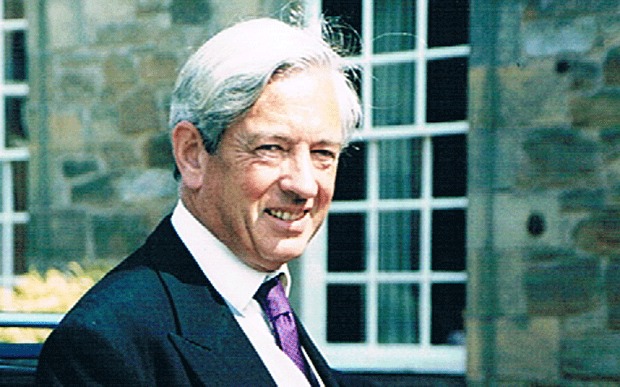
Writing obituaries is a sad business, particularly about someone, in this case Lord Monson, the freedom campaigner, as the Daily Telegraph so rightly called him, whom I knew well and with whom I have worked in the House of Lords.

Melissa Kite's article, quoted above, sums up Lord Monson's activity reasonably well though somewhat superficially. So far there has been no obituary, presumably because active in many different fields, Lord Monson eschewed personal publicity and was not known to many hacks.

Among other things he was a confirmed EU withdrawalist, though he also believed that our own government should also get out of people's lives, a man who opposed surrender to the IRA, a stalwart fighter against the hunting ban, the President of the Society for Individual Freedom, a trustee of the Centre for Research into Post-Communist Economies and others, too numerous to mention.

I first met Lord Monson at the very beginning of the Anti-Federalist League, which later morphed into UKIP. We wanted to launch the new party in one of the House of Lords committee rooms and the rule is that such events have to be sponsored by a member of the House who has to be present. For various reasons the peer whom Alan Sked had asked could not attend so he, in turn, asked Lord Monson to do so. Without knowing any of us (though he did recognize my surname and told me that he had read my father's articles) Lord Monson agreed because he believed in the rightness of the cause. Subsequently, in the 1992 election he persuaded a number of people to vote for the AFL as he could not vote himself.

It was Lord Monson who sponsored my pass to the Lords in order for me to do the research and briefs for various peers; he was among the most trenchant speakers in all the debates over Maastricht, Amsterdam, Nice, the Constitution and Lisbon. Generally speaking, his approach was from the point of view of individual freedom as a cursory glance through his contributions would show. There are not that many people even in the Lords, let alone the Commons, who believe in old-fashioned liberal values but Ivan Monson did. (He asked me to call him Ivan when I first started working with him, promising to explain why and how John had transmogrified into Ivan but he never did, leaving me to guess.)

His other interests were Northern Ireland, Eastern Europe, Turkey where he went frequently and about which he knew a great deal, country sports and activities. I am not sure whether he hunted himself but I do know that he opposed the government's deep desire to control activities in the countryside and took his entire family, including very young grandchildren to the Countryside Alliance march.

My last conversation with Ivan Monson took place a couple of weeks before his death. He was in the Lords (where he had not attended much in recent months, clearly for reasons of health) but on crutches because he had had an operation on one knee and was planning to have one on the other as soon as possible. Sadly, he looked frail and tired but the chat we had was as delightful and invigorating as ever. Among other things he complained bitterly about the number of new peers this government, outdoing the last one, was appointing. They would toe the line, was his opinion. With this lot we probably could not get any Bill of Malcolm Pearson's through the Second Reading, let alone Committee stage. Sad but true.

I shall miss Ivan Monson, a very quiet, gentle but utterly strong-minded man. I am glad to say, however, that arrangements are being made for me to continue work in the House of Lords about which I shall go on reporting on this blog.

UPDATE: A belated and not entirely adequate obituary in the Daily Telegraph.