Friday, December 4, 2015

Those pesky Danes and other matters

Yesterday the Danes voted against further integration into the European Union. As Open Europe says:
Danish Prime Minister Lars Løkke Rasmussen said after the vote, “I don’t consider this as a step back. The Danes have refused to take a step forward…The reasons why Danes refused to choose what we proposed is probably that there’s this feeling of uncertainty given the fact that Europe is right now faced with other major problems which we haven’t really solved.”
Or, in other words, we lost dammit. Now what do we do? The Danes might not like another referendum.

At issue was Denmark's joining fully the EU's justice and home affairs policies. This is how the Danes voted:
The referendum resulted in a large majority - 53.1 percent No, against 46.9 percent Yes - refusing to join EU justice and home affairs policies. Denmark opted out from this part of EU policy when ratifying the Maastricht treaty 22 years ago.

"People wanted to stay in control, and I have great respect for this,” said Liberal prime minister Lars Loekke Rasmussen.

Loekke Rasmussen phoned EU commission president Jean-Claude Juncker and Council president Donald Tusk on Thursday evening and plans to start talks in Brussels on 11 December to secure a parallel deal regarding future Danish participation in Europol, the EU’s joint police body.

Loekke Rasmussen also invited all political parties in the Danish parliament for one-to-one talks on Monday, in order to digest the referendum result and formulate a new Europe policy.

"I have already indicated my support for [UK prime minister] Cameron and his talks ahead of a British referendum to secure continued membership of the EU. We have a strong ally in Great Britain to reform the EU," the Danish PM said.
There is muttering to be heard in various places that this might show the EU that Britain is not the only country that is dissatisfied with the ever closer union and that, in turn, will spur the Eurocrats to being amenable to reforms, particularly as it has now become officially known (as opposed to worked out by all of us who have bothered to think) that the notion of some kind of a deal at the December European Council is moonshine.
British and EU leaders will try to reach a deal on British demands for reforms at February's EU summit, while using the upcoming summit on 17 December for political guidance.

"Debate" at the December meeting "should pave the way for a deal in February," European Council president Donald Tusk said on Twitter on Thursday (3 December).

Tusk announced he will send a letter to EU leaders on Monday (7 December) to give his assessment on the ongoing talks.

In a phone call with Germany's Angela Merkel on Thursday, UK prime minister David Cameron admitted that "the scale of what we are asking for means we will not resolve this in one go.”

Cameron "did not expect to get agreement at the December European Council," his office said after the call.
OK, neither of them is a summit but let us not quibble. Or not too much.

In other related news, a YouGov_De poll has given an unsatisfactory result to the Europhiles: 37% support return to the Deutschmark while 45% want to continue in the euro. Yes, they are still in a majority but it is not exactly overwhelming.

And so we come to UKIP and its performance in the Oldham by-election yesterday. Unfortunately, I have to leave that till another posting partly because I need to vacate this spot but also because I have a certain amount to say on the subject of that result.

Thursday, December 3, 2015

Hansard links

For those readers who want to know what was actually said in those debates yesterday here are the links to the Commons and the Lords.

While we are on the subject, here is the link to the Third Reading of the EU Referendum Bill, which is now through the House of Lords and has gone back, in an amended form, to the Commons where it will be debated on December 8. As I have mentioned earlier, most of the amendments are government ones (another one or two have been passed in the Third Reading) and will be passed in the Commons. The one amendment that will cause problems is Baroness Morgan's that extends the electorate for the referendum to those who will be 16 and 17 by the time it is taking place. Presumably, the Commons will hold out on that and repeal the amendment, sending the Bill back to the Lords again. There is a strong possibility that there will be no Royal Assent before Christmas.

Wednesday, December 2, 2015

Well, that's that

We are going to send the RAF to Syria and strike ISIS territory. The House of Commons debated the issue for most of the day and voted 397 to 223 to authorize those airstrikes. The majority was bigger than many expected. The House of Lords also debated it but, as in 2013, did not divide, merely expressed its mood, which was supportive of the government.

I find myself in a quandary. As I made it clear yesterday, I do not think this is a very good idea. There is no need to go through the arguments again as they are all here. At the moment I prefer not to think about what will happen when the first pictures, helpfully produced by ISIS, of children killed by allied bombs are published.

On the other hand, there is the opposition to the air strikes: the Stop The War Coalition, the people who earnestly assure me that war has never solved anything (I usually suggest that they have a word with people who remember being liberated from the Nazis), the dopy academics one of whom shared a programme on the BBC Russian Service earlier today and whose idea was to try to get a global consensus through the UN, and the screaming, ullulating mob outside Parliament today. As I was leaving the Palace of Westminster about half an hour before the vote was due I saw resigned looks on the faces of the police officers. Whichever way the vote goes, one of them said, there will be trouble. Added to that we have the stories published in various media outlets, even left-wing ones of threats against Labour MPs who had voiced their intentions to vote with the government on the subject and abuse against their staff (a particularly despicable kind of behaviour) and one's convictions begin to waver.

For what it is worth, I still think that we are making a mistake but I can understand that we have placed ourselves in an almost impossible position - we need to solve the Syrian crisis if for no other reason than to stem the flood of migrants but we have no idea how to do it. Getting rid of ISIS, if we can do it, may be the first step towards a solution but my doubts remains.

Perversely though, I am glad that the holier-than-thou rabble did not win.

Tuesday Night Blogs: Ngaio Marsh and Watsonism


Those Tuesday Night Blogs did go on but last month's subject was Ellery Queen and, although I have read a great many of the novels and short stories and consider Ellery Queen and his creators to be of pivotal importance to the history of the genre, I could not think of anything to say that might be even of fractional interest. So different with Dame Ngaio Marsh: I have already lined up several subjects I want to write about and here is the first one: is Nigel Bathgate, the journalist, Roderick Alleyn's Watson?

He is certainly described by many as such by critics and historians of the genre as well as various biographers of Dame Ngaio (her damehood was earned by her work in the New Zealand theatre, which she and everyone else considered more important than her 'tec fiction). Bathgate describes himself as such on a number of occasions and several times he is given that role in the list of characters that the highly theatrical author provided at the beginning of her novels. At other times he is described as a journalist or just simply as Mr Nigel Bathgate (Final Curtain). He does not appear in all or even in the majority of the novels, only in seven of the pre-war ones and two of the post-war ones. His final appearance is in the very weak and wooden Swing, Brother, Swing, in which he is not a Watson but merely a journalist who is after a story and is, in return, prepared to give some information about a somewhat ridiculous magazine Harmony and its contributors. Thereafter he is not seen again though, one must assume that his and his wife's friendship with Alleyn and Troy goes on. For one thing, Alleyn is the young Bathgate's godfather.

Watsonism, to use Dorothy L. Sayers's expression is a curious phenomenon and, it would appear, poorly understood even by practitioners, let alone critics. Miss Sayers, naturally enough, understood it well and talked about it very interestingly in her discussion of The Murder of Roger Ackroyd. But others find the whole thing more difficult. Sandra Roy, for instance, in her book on Josephine Tey suggests that at the beginning Sergeant Williams is Inspector Grant's Watson, a preposterous suggestion, as a Watson cannot be the detective's professional subordinate. Dr Thorndyke's several Watsons are themselves legal medicos - they just do not happen to be brilliant.

As it happens there is another character who claims to be Alleyn's Watson when Bathgate is absent from the plot and that is Col. the Hon. Maxwell Barrington, the preposterous and highly irritating Chief Constable in Death at the Bar. In between breaking every traffic law, snitching cigarettes from anyone who happens to be around and irritating his subordinates Colonel Barrington tells the Chief-Inspector that he wants to be his Watson and that consists of him not listening to any of the conclusions the police have come to but taking away all the notes and trying to work out the solution for himself. When he does so, he expounds it at great length and with mock-modesty as an "essay in Watsoniana", inviting Alleyn to destroy all his arguments. Needless to say, he is deeply shocked when Alleyn does so and even more so when he finds out that the local Inspector had come to the right conclusion and at least one of his great deductions had been made by the inn-keeper's son as well.

Of course, simply looking at all the evidence and getting it wrong is not the only and not even the most important characteristic of Watsonism. A Watson is the detective's companion who is not stupid (with the exception of Captain Hastings) but not brilliant either, he follows the investigation and makes some deductions, which are usually though not absolutely inevitably wrong and he writes up the cases in one way or another. Above all, the story is told from the Watson's point of view whether it is in the first or the third person.

Does Nigel Bathgate confirm to those characteristics? Well, no.

He is very rarely Alleyn's companion from the beginning. In two novels, A Man Lay Dead and Death in Ecstasy he is there from the start of events because he is himself involved. In both of them he is, in fact, the outsider from whose point of view part of the story is written. In only one, Enter a Murderer, does he accompany Alleyn from the very beginning: a friend of Felix Gardener, the star of the play The Rat and the Beaver, he is given two tickets and, his fiancée, Angela being out of town, he invites his friend the Chief Inspector to accompany him. As Alleyn explains at the end, there was a unique aspect to the play [SPOILER ALERT]:
Thanks to you I was able to watch the murder in comfort from a fifteen-and-sixpenny stall provided by the murderer. 
In the other novels Bathgate is visited by Alleyn, who refers to him as his Boswell rather than his Watson, for a discussion (The Nursing Home Murder) or he manages to muscle his way in as a friendly journalist who will help in return for a scoop and is ready to submit to Alleyn's censorship (Artists in Crime and Overture to Death).  In Surfeit of Lampreys he is summoned by that obnoxious family to help them in their difficulties and is seen by the outsider whose point of view is followed through most of the book, Roberta Gray, as a pleasant, red-faced young man with a moustache.


Bathgate's own comment is: "As you know I'm Alleyn's Watson." Alleyn describes him as "keeping a briefing watch" and adds:
Bathgate is remarkably well equipped as a liaison officer between the press, yourselves and the police.
Somehow one cannot imagine Sherlock Holmes saying that about Dr Watson. Bathgate, one assumes, remains the Alleyns' friend but is ever more distant from the investigation. In Final Curtain he is seen briefly, still in uniform though he is back at his job as a journalist (could he have been a military correspondent during the war?) when he hands over his description of the rather ghastly Ancred family whose patriarch, the great Sir Henry Ancred, the GOM of British theatre, Troy is about to paint. He is then heard on the telephone informing Alleyn of the latest development in the twisted saga of the Ancred Will.

The final appearance is in Swing, Brother, Swing where he is described as of the Evening Chronicle, having been of the Evening Mirror before the war. As usual, he appears in Alleyn's office, hoping for a scoop and is allowed in on some of the investigation though considerably less than in the earlier novels. In return he provides information about the world of journalism.

It is true that in the earlier novels Bathgate, usually with his fiancée Angela North is sent off to find out a few things about the doings of some ridiculous Soviet club (A Man Lay Dead and The Nursing Home Murder) or to discuss matters with a suspect or two (Death in Ecstasy). He is asked several times to sit quietly in the corner and take short-hand notes and off his own bat he produces notes and summaries of the cases, which may or may not help Alleyn. He also writes the cases up in his "rag" though we never read those articles and assume them to be on the popular side. He writes about Alleyn between cases as well and is, probably, the author of that embarrassing soubriquet "Handsome Alleyn".

Above all, we do not see events from his point of view except in the two that he begins by being invited to a country house week-end (A Man Lay Dead) or by wandering into the ceremony of a shady cult and witnessing a murder (Death in Ecstasy). Ngaio Marsh was quite fond of the outsider from whose point of view all or part of the novel is written and in those two it happened to be Bathgate. In others we have two recent arrivals from New Zealand (Roberta Gray in A Surfeit of Lampreys and Martyn Tarne in Opening Night), the secretary of a great Shakespearian actor, stuck in New Zealand during the war and longing to get back to Britain (Colour Scheme) or even Troy Alleyn (Artists in Crime, Final Curtain and, especially, A Clutch of Constables). The tiresome Ricky Alleyn acts as the outsider in Last Ditch. Other novels have other outsiders but once the investigation begins, with very few exceptions, it is Alleyn from whose point of view the story is told. There is no Watson in those novels.

It would be interesting to know why Marsh abandoned Bathgate after Swing, Brother, Swing. He could have carried on being a journalist who popped up from time to time, offering help and demanding a (moderated) scoop, giving news of his wife and son, who is Alleyn's godson, taking the Alleyns and their friend Katti Bostock out to the theatre as it is mentioned at the beginning of Final Curtain. For some reason she decided against that.

Tuesday, December 1, 2015

Back to the question of intervention in Syria

We have been here before, only last time the question was about intervening in order to overthrow Assad. This time the discussion is about intervening against ISIL from which Assad may benefit. The debate is set for tomorrow and it would be a foolhardy person who could predict its outcome. To me these debates show the futility of running a foreign policy according to popular opinion, which tends to change in response to media stories and pictures, something I discussed on the blog not so long ago.

Back at the time of people demanding that we go in to unseat Assad, who has remained considerably more tenacious in his grasp on some power than people predicted and who is still responsible for more deaths than ISIL (though that is probably merely because he has been there for much longer), I wrote this:
However, ladies and gentlemen who demand that we intervene in Syria, could you answer at least some of the following questions?

When you say you want us to intervene what kind of intervention do you have in mind and who, do you think, should carry it out? What precisely is a limited military intervention, as suggested by Senator McCain?

What sort of timetable do you have in mind? Weeks? Months? Years? A long occupation with no foreseeable end and if so, who would be doing it?

What would be the agreed aim of the intervention? Simply no more pictures of dead bodies? How can we ensure that? Regime change? I have no problems with that in principle (think Germany, Japan and Italy in 1945) but what sort of regime should we install and how long will it survive?

Do we have any identifiable allies?

And last but very much not least: what is the exit strategy?
With a few changes those questions are still relevant. Obviously, if we are talking only about extended bombing (people seem not to have noticed that we are already involved in it to some extent) then the urgency of those questions is not so great. Even bombing, as was carried out in Libya, now a completely dysfunctional state, carries with it certain consequences. What if we actually put boots on the ground in a civil war, which has many sides, all of them nasty and few potential allies?

Another update

Third Reading of the EU Referendum Bill in the House of Lords will take place this afternoon. It is described as a "final chance" to tidy up the Bill and there has been a good deal of tidying up already. However, it has also been amended on the question of voting rights and will, therefore, have to go back to the Commons. We are likely to see a bit of toing and froing. Here is the Bill as it is now.

Another loss to the Brexit movement

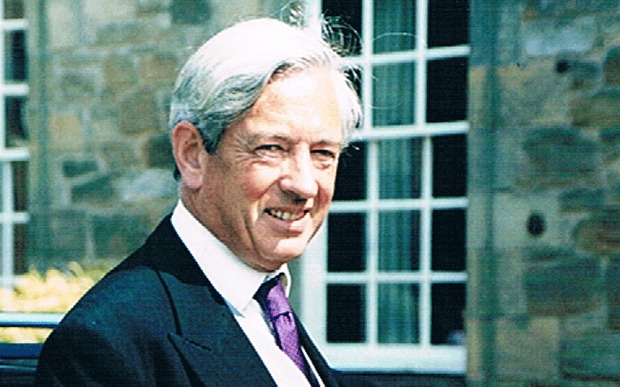
A friend called my attention to this obituary in the Daily Telegraph telling me about the death of Ronald Stewart-Brown, which I knew nothing about. As one is at times like that, I was shocked, having seen Ronald at one of the many Brexit meetings and discussions a few months previously. He did not look well but I had no idea just how unwell he was.

There can be few people in eurosceptic circles who did not know or had not seen Ronald Stewart-Brown at various meetings. A tall man with a forward leaning loping walk he had a ready smile, usually accompanied with a nod for all those many people he actually knew and any amount of time to discuss matters to do with the EU and, particularly, trade and what Britain's future might be if we come out.

One of my early meetings with Ronald was when I was working at the European Foundation. We had met and chatted before and one day he suggested lunch, mainly to discuss what his role might be in the eurosceptic fight. I don't think we came to any conclusion at the time but we resumed discussions in person and over the telephone on a number of occasions. Eventually, Ronald did find the right niche for himself: he set up the Trade Policy Research Centre and concentrated through research, published papers and discussions on building up a credible policy of an alternative trading network to EU membership. Inevitably, his ideas brought him into conflict with other people whose own ideas were just as strongly held if not always based on quite as much research. Ronald argued his case courteously but vehemently: his manners remained excellent but he would not be shifted from what he considered to be the right analysis. At the same time he was ready to listen to other people's opinions and there were times when I was embarrassed by his insistence on wanting to know what I thought on certain subjects.

At our last meeting we chatted as always and I expressed a certain amount of boredom with the whole subject of the EU. Having been involved in the debates for so long I did not think I could work up any enthusiasm now, though the situation was becoming critical. Ronald's response was characteristically complimentary and robust. First of all, he did not think that this was the time to give up or succumb to ennui. Of course, he added with a smile, you were so far ahead of us all those years ago, most of us are only just catching up. He intended to go on working and fighting as long as it was necessary and urged me to do the same. Alas, his time was considerably shorter than I realized.

We shall all miss his incisive and knowledgeable contribution to the coming debates.