Sooner or later one has to look at Rex Stout's biggest character (and at one seventh of a ton that is le mot juste for him) and that is Nero Wolfe. Looking at Wolfe means looking at Archie Goodwin, the entire household in West 35th Street and other recurring players: Saul Panzer, Fred Durkin, Orrie Cather and the police officers: Inspector Cramer, Sergeant Stebbins and Lieutenant Rowcliff as well as assorted patrolmen.
For various reasons I did not take part in the group blogging last Tuesday but others did and they can be read on Noah Stewart's blog and, indeed, he is in the process of collecting this week's contributions.
\
As this is the last week of the Rex Stout Tuesday Night blogs I thought I'd go back to the very first novel about Nero Wolfe that I read. I had heard about Rex Stout, of course, and about Nero Wolfe but was not altogether clear about things. Soon after I went to Oxford I set up an account at Blackwell's (can one still do that, I wonder) and spent some time wandering round the shop. On my second visit I came across a recently reprinted Penguin version of Murder By The Book, originally published in 1951, a good many years before it came into my hands. It cost 40p (oh those halcyon days!) and the copy is still in my possession.
I was lucky with my first Nero Wolfe novel - it has a reasonably good plot that stands up to scrutiny even after we know the not particularly surprising solution. In any case, one does not read Stout for the plots. For the style, yes. It has a light crispness and speed that is hard to find in other writers' work. There is a similarity with Chandler but Archie Goodwin has no pretence to being a chevalier sans peur et sans reproche. Nor does he find life a hardship. His account of events is blithe but never off the mark.
Consider this as a novel read by someone who is a stranger to the great world of Nero Wolfe. Within two pages we establish the relationship between Nero Wolfe and Archie Goodwin and between either of them and Inspector Cramer, who is, it is clear, a reluctant admirer of the large detective. Within the next few pages we have a clear idea of the household, of Fritz Brenner, the Swiss chef who is a genius and of Theodore Horstmann, the orchid man; of the fact that Wolfe hates working though rather likes displaying his superior mental powers (Archie goofs a couple of times in this one, which is unusual); that the entire household revolves round Wolfe's timetable and that revolves round his food, his orchids, his books and the London Times crossword All this is conveyed in taut prose though with many details (who would not like to try Fritz' breakfasts or go dancing with Archie?) and around a fairly complicated plot that involves a trip by Archie to Los Angeles as well as an inebriated dinner party for all the secretaries in a law firm. All in 188 pages.
Beyond the style, the characters, the ambience and, in this case, a decent plot there are some fascinating glimpses. A number of times various people, including Archie, when challenged by the police demand to know whether they have somehow been transported to Communist Russia? From a basically left-wing writer like Stout that is interesting.
Then there is the attitude to women. Throughout the novels we know that Wolfe is a misogynist and there is some kind of a ridiculous reason for it that goes back to his youth in Montenegro. But Archie, who likes women or, at least, pretty young women, shares his contempt. Women, according to this novel, are incapable of thinking, tell lies as a matter of principle and find it impossible to appreciate good food and good wine. If a married woman in her late forties is working then her marriage must be very unhappy. Whereas a perfectly intelligent young woman whom Archie goes to see in LA appears to spend her time at home doing precious little while her husband is at work. Of course, the book was published in 1951, the beginning of a decade that some people seem to want to go back to.
Finally, the lawyers. About a third of the way through it becomes obvious that at the heart of the crimes there is the year-old disbarment of a trial lawyer who had bribed a juror. The question is who reported on him and how did that develop into a badly written novel whose author, editor and typist have all been murdered. Without giving away the ending I have to say I found it a little odd that the trial lawyer who had been disbarred is viewed by most as something of a victim, someone to whom a rather serious misfortune had happened. This, I could not help thinking, was a very odd way of looking at events.
So that was my introduction to Rex Stout and the brownstone in West 35th Street (no, there are no brownstones in that part of Manhattan so Archie must have been misleading readers for all those years) and I was hooked. Many Stout novels and novellas later I can recite with ease Wolfe's time table and Archie's peculiar likes and dislikes. I can remember quite a few of the meals and Archie's quips as well as his rows with the police officers. What I quite often forget, however, is the plot. They are not always and not even usually memorable.
Showing posts with label Rex Stout. Show all posts
Tuesday, January 26, 2016
Wednesday, January 13, 2016
Tuesday Night blogs: Rex Stout's other detectives
Before I go into the main body of the posting, I need to point out that, although the Rex Stout blogs are collected by Noah Stewart, as I wrote last time, the wonderful logo was created not by him but another of our merry band, Bev Hankins, who writes the fascinatingly titled blog, My Reader's Block.
I am still working round the edges of Rex Stout's work, in that this posting is not about Nero Wolfe and his household or his assistants, although one of his other detectives, Theodolinda Bonner, a she-dick as Archie Goodwin disrespectfully refers to her, and partner in Bonner and Raffray Detective Agency, does appear a few times in the main body of work.
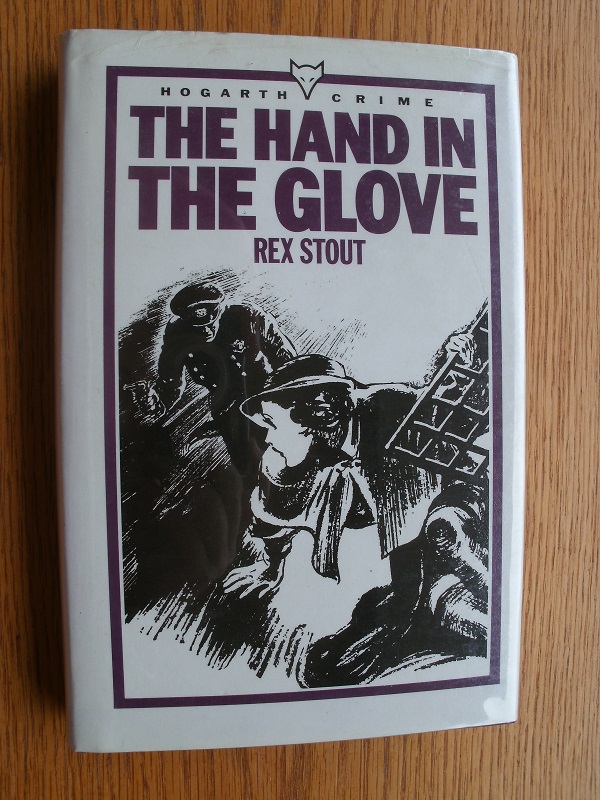
Theodolinda "Dol" Bonner is a disappointment though her appearances together with her assistant Sally Corbett in several Nero Wolfe novels are satisfactory enough. Wolfe thinks highly enough of her and her agency to employ them at the same time as Saul Panzer and his other agents. The disappointment lies in the one novel about Dol Bonner, The Hand in the Glove. The plot is odd though at times credible and Dol Bonner's much discussed hatred of men turns out to be based on something completely piffling. The arguments about whether the two young ladies should be running something so disreputable as a detective agency are entertaining enough and strike a chord. (How different from our own Miss Maud Silver, well established as a private investigator by 1937.) But on the whole, it is far inferior to Rex Stout's other books.
About the same time, that is in the late thirties and early forties Stout also experimented with another detective, William Tecumseh Sherman Fox, named after the Civil War general of controversial fame and known as Tecumseh or Tec Fox. So far I have managed to read only one of the Tec Fox novels, the last one, as it turns out, The Broken Vase.
Its plot is a little bonkers and involves fabulously beautiful and expensive Chinese vases, one of which is broken and one stolen as well as a very special Stradivarius violin, which is wrecked beyond repair by the end of the book, a number of varied murders and a cast of characters all of whom act in the stupidest way imaginable except for a Hollywood star of great beauty who seems completely dulalee. The only people who appear to keep their senses are Tec Fox himself, Mrs Pomfret (allowing for overwhelming grief) who hires him and, surprisingly, Inspector Damon of NYPD homicide.
Readers who are used to the sparring and snarling that goes on between Wolfe and Archie on the one hand and Inspector Cramer and his subordinates on the other, will find the open and friendly collaboration between Tec Fox and Inspector Damon rather surprising.
In fact, Fox is altogether surprising. He appears to own a farm in Westchester County where there are livestock, strawberries, vine and other fruit and vegetables as well as mostly random human inhabitants. Whether his main income is from the farm or from detecting is not made clear in this book but one suspects the latter. He drives into New York or anywhere else he needs to get to and frequents places that are mentioned in the Wolfe stories as well. In The Broken Vase, for instance, he and his buddy Diego (who also behaves like complete idiot) go for a late night drink and sandwich to Rusterman's. There are, apparently, other links in the other two novels though the two detectives never meet and never mention each other.
Tec Fox is not a genius but is knowledgeable about a number of unexpected subjects and solves the crimes in The Broken Vase through his ability to play with words and some knowledge of Latin. That and the inimitable Stout writing style, toned down a little as it is not Archie who is supposedly telling the tale but a narrator, make me think that I want to read the other two Tecumseh Fox novels and regret that there were only three.
Wednesday, January 6, 2016
Tuesday Night Blogs: Was Rex Stout right about Watson?
Another month, another writer: this time it is Rex Stout and the blogs will be collected by Noah Stewart who also designed that very fetching logo for the blogs. Eventually I shall get round to writing about Nero Wolfe, his assistant and general dog's body but every woman's dream Archie Goodwin, the brownstone house in West 35th street, which has not brownstones indicating that a misleading address was given, Fritz Brenner the astonishing cook and Theodore Horstman, the orchid expert who seems to live at the top of the house, never making an appearance anywhere else. Eventually.
First, let me turn to Rex Stout the innovator in Holmesian studies. Let me call attention to a couple of modern works. First, there is the series Elementary, according to some experts far better than our own Sherlock (go tell that to the Cumberbitches), which is an updated version of Sherlock Holmes with a female Dr Watson, played by Lucy Liu.
Secondly, there is a whole series of novels by Laurie R. King about Mary Russell (more here), whom we first meet as a difficult teenager, helped in life by a certain bee-keeper on the Sussex Downs. In subsequent novels she grows up, acquires an excellent education, becomes said bee-keeper's assistant and wife. Guess who the bee-keeper might be?
So there we have it: a series about Dr Watson as a woman and a series about Sherlock Holmes married. But who thought of that first? That's right, Rex Stout. At a meeting of the Baker Street Irregulars on January 31, 1941, Stout made a speech that became infamous among Holmesians and, we are told, he could attend subsequent meetings only when accompanied by a personal bodyguard.
He refused to join in the traditional toast "The Second Mrs Watson" because, he explained, there was no such person. Nor was there a first Mrs Watson. In fact, the Watson person, as he said was a very different entity from the one we assume.
Going through the Sacred Texts, as he refers to them, Rex Stout proves that Watson could not possibly have been a man. Mind you, I cannot quite see why a man should not ask a good violinist to play some of Mendelson's Lieder, that being one of Stout's arguments. Others stand up a little better.
Next, he says, we have to ask whether the Watson person was his wife or his mistress. Well, that's easy: no man would go on crunching on his toast when his mistress finally appears at the breakfast table. It had to be a wife.
The Great Hiatus? Piffle. That was Holmes wanting to escape from a marriage he hated but deciding to come back after all. And so on. There is an interesting explanation as to when Holmes married. It was, of course, during the only wedding that he attended in the entire canon. He was not, apparently, a happy groom.
Well, maybe. But where Stout falls down, in my opinion, is in his analysis of what Watson's real name might be.
First, let me turn to Rex Stout the innovator in Holmesian studies. Let me call attention to a couple of modern works. First, there is the series Elementary, according to some experts far better than our own Sherlock (go tell that to the Cumberbitches), which is an updated version of Sherlock Holmes with a female Dr Watson, played by Lucy Liu.
Secondly, there is a whole series of novels by Laurie R. King about Mary Russell (more here), whom we first meet as a difficult teenager, helped in life by a certain bee-keeper on the Sussex Downs. In subsequent novels she grows up, acquires an excellent education, becomes said bee-keeper's assistant and wife. Guess who the bee-keeper might be?
So there we have it: a series about Dr Watson as a woman and a series about Sherlock Holmes married. But who thought of that first? That's right, Rex Stout. At a meeting of the Baker Street Irregulars on January 31, 1941, Stout made a speech that became infamous among Holmesians and, we are told, he could attend subsequent meetings only when accompanied by a personal bodyguard.
He refused to join in the traditional toast "The Second Mrs Watson" because, he explained, there was no such person. Nor was there a first Mrs Watson. In fact, the Watson person, as he said was a very different entity from the one we assume.
Going through the Sacred Texts, as he refers to them, Rex Stout proves that Watson could not possibly have been a man. Mind you, I cannot quite see why a man should not ask a good violinist to play some of Mendelson's Lieder, that being one of Stout's arguments. Others stand up a little better.
Next, he says, we have to ask whether the Watson person was his wife or his mistress. Well, that's easy: no man would go on crunching on his toast when his mistress finally appears at the breakfast table. It had to be a wife.
The Great Hiatus? Piffle. That was Holmes wanting to escape from a marriage he hated but deciding to come back after all. And so on. There is an interesting explanation as to when Holmes married. It was, of course, during the only wedding that he attended in the entire canon. He was not, apparently, a happy groom.
Well, maybe. But where Stout falls down, in my opinion, is in his analysis of what Watson's real name might be.
Let us see what we can do about the name, by methods that Holmes himself might have used. It was Watson who wrote immortal tales, therefore if she left a record of her name anywhere it must have been in the tales themselves. But what we are looking for is not her characteristics or the facts of her life, but her name, that is to say, her title; so obviously the place to look is in the titles of the tales.You can find the answer in the text of the essay here. It will not surprise anybody. However, I cannot accept the explanation above. For one thing, the numbers are far too randomly chosen and many others would have done just as well with the answer being very different. Most importantly, however, would anyone in England of that time know anything about crap shooting? This was long before the film of Guys and Dolls remember. Rex Stout's case remains unproven.
There are sixty of the tales all told. The first step is to set them down in chronological order, and to number them from 1 to 60. Now, which shall we take first? Evidently the reason why Watson was at such pains to conceal her name in this clutter of titles was to mystify us, so the number to start with should be the most mystical number, namely seven. And to make it doubly sure, we shall make it seven times seven, which is 49. Very well. The 49th tale is "The Adventure of the Illustrious Client." We of course discard the first four words, "The Adventure of the," which are repeated in most of the titles. Result: "ILLUSTRIOUS CLIENT."
The next most significant thing about Watson is her (his) constant effort to convince us that those things happened exactly as she (he) tells them; that they are on the square. Good. The first square of an integer is the integer 4. We take the title of the 4th tale and get RED-HEADED LEAGUE."
We proceed to elimination. Of all the factors that contribute to an ordinary man's success, which one did Holmes invariably exclude, or eliminate? Luck. In crap-shooting, what are the lucky numbers? Seven and eleven. But we have already used 7, which eliminates it, so there is nothing left but 11. The 11th tale is about the "ENGINEER'S THUMB."
Next, what was Holmes's age at the time he moved to Baker Street? Twenty-seven. The 27th tale is the adventure of the "NORWOOD BUILDER." And what was Watson's age? Twenty-six. The 26th tale is the adventure of the "EMPTY HOUSE." But there is no need to belabor the obvious. Just as it is a simple matter to decipher the code of the Dancing Men when Holmes has once put you on the right track, so can you, for yourself, make the additional required selections now that I have explained the method. And you will inevitably get what I got:
Subscribe to:
Posts (Atom)