Showing posts with label freedom of speech. Show all posts

Saturday, October 8, 2016

More about what is going on in Hungary

That referendum in which everyone was victorious has been superseded by other news. The first I heard of it was through an e-mail from a friend who is the Director of the Free Market Foundation in Hungary.  [The website is in Hungarian but if you ask Mr Google nicely he will give you a rough translation.] This is what Máté Hajba wrote:
Today is a dark day in Hungary's history. The already battered freedom of the press has suffered yet another blow, this time with the suspension of the biggest and one of the oldest Hungarian daily newspapers, Népszabadság.

The newspaper was a prestigious news outlet with excellent pundits. Free Market Foundation didn't agree with the position of the paper all the time, nevertheless we were on friendly terms, and they often reported on our activities favourably.

The publisher of Népszabadság has been recently bought by someone close to the Hungarian Prime Minister Viktor Orbán, who allegedly directed the purchase and the suspension of operations, as the newspaper had been uncovering sensitive details regarding corruption in the governing party Fidesz.
According to the Agence France-Presse story as published in the Telegraph, the sale is merely being rumoured.
On Saturday there was speculation that Népszabadság might also be soon sold to an Orbán ally, but Mediaworks, owned by a Austrian media magnate, made no mention of any sale.
Mediaworks is insisting that the decision to suspend the newspaper's publication has been made for entirely business reasons as the newspaper, despite being Hungary's biggest-selling broadsheet is a loss-making enterprise and some rethinking is necessary.
Mediaworks, which bought Nepszabadsag and several other Hungarian titles in 2014, said that its circulation had tumbled by 74 percent in the last 10 years, racking up losses of around 5 billion forints (16.4 million euros, $18.4 million).

The title must try to find a business model appropriate to market trends, the company said, calling on "all affected by the move to concentrate on that task".
Curiously enough, nobody really believes that and the ineffectual socialist opposition has called for a demonstration outside the newspaper's offices. If it happens, it is likely to be joined by people who do not support the various left-wing parties but are, nevertheless, alarmed at another example of the Hungarian government's propensity to control the media.

Meanwhile, here is a statement from Zoltán Kész who was Director of the Free Market Foundation and is now its Honorary Chairman as well as an independent MP [and a friend of mine]:
Hungary must unite and put an end to this rampage. Enough is enough. The government is disregarding European values and common sense. It is only power that matters to them, as with power they can steal as much money as they want. Corruption is running high in Hungary and the governing politicians are getting rich on the taxpayer and the EU, while the former gets nothing in return and the latter is being attacked by Viktor Orbán.
As a matter of fact there is a good deal of EU money being poured into Hungary but its destination is often mysterious and Hungary's economy is in a parlous state as witnessed by the huge exodus of young and not so young, often highly qualified, people.

Nevertheless, Orbán is not Putin and opposition figures are not exiled, imprisoned, beaten up or murdered. Whatever people thought of that referendum, there were no complaints of stuffed ballot boxes and nor have there been any about past elections. So why is the opposition not capable of organizing itself adequately?

Monday, September 26, 2016

Yes, we shall control the past

Some time ago I wrote about the trial of Vladimir Luzgin from Perm who had the unparalleled audacity of writing on a social media outlet that in September 1939 the Soviet Union invaded Poland, admittedly more than two weeks after Germany had done.

Slightly belatedly I have found out that the conviction has been upheld by the Russian Supreme Court.
It is probably no accident that the ‘offending text’ should be Ukrainian, and fairly nationalist, however it was specifically over the following paragraph in the repost that the criminal proceedings against Luzgin were initiated:

The communists and Germany jointly invaded Poland, sparking off the Second World War. That is, communism and Nazism closely collaborated, yet for some reason they blame Bandera who was in a German concentration camp for declaring Ukrainian independence.

Russia’s Supreme Court has now agreed that this paragraph constitutes “the public denial of the Nuremberg Trials and circulation of false information about the activities of the USSR during the years of the Second World War”.
The trial, appeal, the various testimonies and final decision are so bizarre as to defy any kind of sense.
It is hard to know what is most shocking in all of this. A prime contender must be Alexander Vertinsky, dean of the History Faculty of the Perm Humanitarian-Pedagogical University. He proved willing to appear for the prosecution and claim that the paragraph really did contain “statements that do not correspond with the position accepted at international level”.

There are also two Russian courts willing to agree that since the Nuremberg Trials did not mention the Soviet invasion, the information was ‘knowingly false’. With the Soviet Union as one of the victors exerting considerable influence at Nuremberg, it was highly unlikely that Soviet collaboration with the Nazis and its invasion would get a mention.

The rulings are extraordinarily cynical. Whatever was said at Nuremberg, any genuine historian will confirm that the Soviet Union invaded what was then Poland on September 17, 1939.

To deny this is absurd when the Molotov-Ribbentrop Pact and its secret protocols which carved up Poland between the Soviet Union and Germany have long been in the public domain, and can be read about in any history book.
The notion that history is to be written according to what was and what was not said at the Nuremberg Trials that were nothing more than the victorious powers finding a way of dealing with the defeated enemy and an otherwise intractable situation is preposterous. A great deal was not said at those trials.

Nobody talked about the Katyn murders though there had been a Soviet suggestion of introducing those as part of the indictment. The other Allied prosecutors refused to support that, thus proving that they and their government knew at the time who was responsible and the idea was dropped. Nobody was tried for those, not at Nuremberg, not anywhere else. Are we not to mention Katyn in history books?

As I have mentioned before (probably a few times) the Great Patriotic War remains the one great untouchable myth in the Russian psyche and in order to preserve it they would prefer not to know how much of the death and suffering was the outcome of Stalin's policies. Most certainly, there can be no discussion of anything that might throw a negative light at the country or any of the people, either at the top or lower down.

Without acknowledging the truth, which will show the people of the Soviet Union (not just the Russians but many others) to have fought and suffered with great courage as well as having committed various war crimes as a country and as individuals, Russia cannot move forward.

Meanwhile, Luzgin's lawyer, Henry Reznik is promising further appeals, probably to the European Court of Human Rights.

Friday, July 1, 2016

The past has to be controlled as much as the present

No, I still do not think that Putin is another Stalin or Hitler (and for that we may be truly grateful) but some of the ideas are worryingly similar. No, it does not surprise me - no country could have gone through what the various parts of the Soviet Union did for seventy years and emerge with sanity intact. Nor was there enough time to recover in Russia before Putin's rise to the top.

We have news of another trial of someone posting inconvenient truths on social media. This one is a little unusual.
Vladimir Luzgin, a 37-year-old man from the Siberian city of Perm, was prosecuted, convicted, and fined 200,000 rubles ($3,100) for posting an article on social media containing the well-known historical fact that the Soviet Union in collaboration with Nazi Germany invaded and partitioned Poland in 1939.
It is no longer the present that matters but the past as well - the factual truth cannot be told about either.


The Great Patriotic War remains the one sacred untouchable in Russia and the truth about Stalin's role in the high casualty rate, the Nazi-Soviet Pact or what happened in the reconquered Soviet territories and the conquered East European ones in 1944 - 45 cannot be told. Curiously, there is a kind of an ambivalence about attitudes. When there is talk about Soviet crimes, Russians rightly point out that they were not the only ones doing them - the other nationalities were involved as well. All were victims and executioners. But when it comes to the Great Patriotic War, only Russians appear to have fought and suffered. The ease with which Ukrainians, literally Russians' brothers and people who fought and suffered much in the war, could be described as fascists, carrying out fascist policies as laid down by the German invaders all those decades ago, did quite genuinely shocked me. I thought the Russian people will not accept Ukrainians as the enemy. Many did not but far too many did.

A fascinating article by Ksenia Polouektova-Krimer on Open Democracy describes the constant frenzy about the Great Patriotic War and how it is whipped up by the government for its own purposes.

Wednesday, June 1, 2016

Twitter has odd ideas about freedom of speech

Apparently, mocking President Vladimir Putin (a.k.a. Vlad the Impaler - there I said it) is akin to hate speech. How else can one explain the fact that Twitter suspended indefinitely the account @DarthPutinKGB. In the past they suspended an account that was mocking the Kremlin run media outlet Sputnik (@SputnikInt) on the spurious excuse that the name was too similar and could confuse people. Actually, it could, as the tweets put out by the official Sputnik are so preposterous.

The mockery was resumed under a new handle, @Sputnik_Not with a strap line: We're Not Tellin' The Untold. Twitter might decide to ban this one as well but they cannot pretend that it is too much like the official account.

Now they have decided to suspend @DarthPutinKGB though there has been no explanation even along the lines of it being just like the real account, whatever that might be. The whole thing has been put into perspective by Brian Whitmore on the Morning Vertical, RFE/RL. A sad state of affairs.

UPDATE: Apparently it's back: https://twitter.com/DarthPutinKGB

But just in case it disappears again, here is the hashtag to use: #NoTwitterGulagForDarthPutinKGB

Friday, May 27, 2016

More on Putin's hostage taking politics

We interrupt our postings on the Referendum campaigns to bring you some information about President Putin and his hostage taking campaign. Here is an item on today's Daily Vertical
Russia may have released its most famous hostage, but it is still holding dozens more.

According to human rights groups, as many as 30 Ukrainian citizens remain in Russian prisons on what appear to be very flimsy charges.

Among them are Stanislav Klykh and Mykola Karpyuk, two Ukrainian nationalists who were sentenced yesterday to long prison sentences on dubious charges that they fought alongside Chechen separatists in the 1990s.

There are allegations that the two were tortured.

Their conviction was largely based on the testimony of one man.
The witness in question appears to be in prison himself and, therefore, subject to some pressure. Were the two even in Chechnya? Who knows?
The hostage list also includes the Ukrainian filmmaker Oleh Sentsov and activist Oleksandr Kolchenko, Crimea residents imprisoned on absurd terrorism charges after they openly opposed Russia's forceful and illegal annexation of the peninsula.

And then there is the 73-year-old Ukrainian pensioner Yuriy Soloshenko, who is suffering from cancer. He's serving a six-year sentence in a maximum security prison on clearly absurd spying charges.

Numerous Crimean Tatars, including the deputy head of the Mejlis, are also incarcerated on fictitious terrorism charges.

Not surprisingly, Vladimir Putin's Ukrainian hostages were all abducted after Russia's seizure of Crimea and its intervention in the Donbas.
Let us not forget various Russian political prisoners, foremost among whom is Oleg Navalny, Alexey Navalny's brother, also a hostage in a manner of speaking, though his imprisonment did not achieve the desired result.

[Referendum campaign anger service will resume forthwith with the criticism already received taken into account.]

Wednesday, May 25, 2016

Rejoice but do not forget


Two good news items today: the release of Nadiya Savchenko and of the investigative Azerbaijani journalist Khadija Ismajilova. Of the two, oddly enough, straightforward rejoicing is in order more with the latter.

Khadija Ismayilova was released on probation by the Supreme Court of Azerbaijan on appeal after a world-wide campaign. (An addition source of satisfaction is that this was not achieved by the egregious Amal Clooney who was taking the case to the ECHR.)
Ismayilova, who had delved into the wealth of the country’s first family, was arrested in December 2014 and sentenced to seven-and-a-half years in jail in September last year.

The supreme court ruled on Wednesday that her sentence would be changed to a three-and-a-half-year suspended term. A group of wellwishers gathered outside the court with balloons to celebrate the verdict, which has come two days before Ismayilova’s 40th birthday. She is expected to leave detention later in the day.

Her trial, on charges of tax evasion and embezzlement, was widely seen as politically motivated, and revenge for her award-winning reporting. In her work for Radio Free Europe/Radio Liberty (RFE/RL), she carried out a number of investigations that linked president Ilham Aliyev and his family to alleged corruption scandals.

At the same time as Ismayilova’s arrest, Azerbaijan’s authorities also raided RFE/RL’s Baku bureau and sealed it shut. The oil-rich country is run by Aliyev, who took over when his father died in 2003, and little dissent is tolerated. A number of other rights activists, journalists and lawyers have been imprisoned in the country on charges widely decried as politicised, though a group of them were released earlier this year.
Either the Supreme Court in Azerbaijan is more independent than any of us had believed or, much more likely, the Aliyev family is relatively sensitive to Western reactions and attitudes.

One cannot say the same about Vlad and his Chekists who are about as sensitive as a rhinoceros is to tickling (don't try it at home).

Nadiya Savchenko, Russia's most famous hostage, as RFE/RL says, was also released today, having been pardoned by President Putin after fairly long imprisonment, stretches of hunger strike, a show trial overwhelming in its ludicrousness and a twenty-two year sentence. She is not simply being released, though, but exchanged for two Russians, Yevgeny Yerofeyev and Alexander Alexandrov, who had been described during their trial in Ukraine as being
elite members of Russian military intelligence - but Russia insisted they were not on active duty when they were captured in eastern Ukraine.

They were sentenced to 14 years in jail last month after being found guilty of waging an "aggressive war" against Ukraine, committing a terrorist act and using weapons to provoke an armed conflict.
They, too, have been pardoned by President Poroshenko.

So Savchenko's release is a little more complicated than Ismayilova's conditional one. As Brian Whitmore says on The Morning Vertical
And as for Russia, Savchenko was just the most high-profile example of Moscow's recent habit of hostage-taking: of snatching foreign citizens from their homelands and forcing them to endure ridiculous show trials in Russia. That list runs from Estonian law-enforcement officer Eston Kohver, who has been released, to Ukrainian film director Oleh Sentsov, who has not. For those released, the pattern is similar: the abduction, the transparently absurd charges and cover story, the show trial, and finally the exchange for Russians who have committed actual crimes.
Expect more of the same in the near future.

Friday, November 13, 2015

Other news from the House of Lords - 2

Meanwhile, Lord Pearson of Rannoch is conducting his own campaign, which consists of two aspects: firstly, it is time we started talking about Islam seriously and without fear and, secondly, the moderate or anti-extremist Muslims should be drawn into that discussion. The campaign has not advanced very far as yet but it is moving forward slowly.

On November 5 (one wonders whether the powers that be recognized the appropriateness of the date) the noble Lord had a Starred Question:
To ask Her Majesty’s Government whether, as part of their counter-extremism strategy, they will encourage a national debate about the nature of Islam, including whether the Muslim tenet of abrogation remains valid today.
Sadly, I have to report that the brief debate that followed the Question was not on a particularly high level, consisting largely of statements disguised as questions about how shocking and divisive such a suggestion might be.

While this blog agrees with the notion that the state has no place in organizing religious debates and discussions, the Question refers to "encouragement" rather than "organization". There are many debates going on about major and not so major religions and nobody thinks that they are divisive. Why exactly should Islam be excluded?

As to why it might be a good idea to include such a debate or discussion in the "counter-extremism strategy", it would be hard to deny that the terrorist threat we face at the moment is tied in with certain groups in the Muslim community. For that very reason the many other Muslims should have a chance to take part in such a discussion and distance themselves from the extremists, their supporters and propagandists and not just the terrorists.

As it happens, I do know that there are many Muslims in this country who are actively fighting the good fight and they are not given nearly as much support either by HMG or by the media, especially not the BBC, though they are often in real danger.

Lord Pearson has also, with the help of a couple of experts on the subject, produced a paper, entitled Shall We Talk About Islam?, which, I am assured by his office, will be on-line very soon. As soon as that happens, this blog will link to it. In the meantime, let me quote the introductory paragraphs:
Have you noticed that when we try to discuss Islam, we are immediately accused of stirring up religious hatred or of being Islamophobic bigots etc? But we can say what we like about any other religion?

We are surprised by how little our friends and acquaintances know about Islam, which contains perhaps the greatest threat facing our Judaeo-Christian civilization.

So here is a memo on some of the basic facts about Islam. It may be controversial, but we hope it will encourage a long overdue national debate.
What follows is a number of points about Islam and the Qur'an, with references to the accepted texts.

The memo has been sent to members of the House of Lords and to Opinion Formers with a suggestion to the Guardian newspaper, in particular, given their previous attacks on Lord Pearson that they preside over a serious debate. It does not have to be the Grauniad. Any other media outlet could do it.

Saturday, September 26, 2015

And that is why we need Passion For Freedom

Passion For Freedom is not an organization many people know about it, which is a pity. This is what they say their aim is:
What we do:

Create space for artists and writers who discuss subjects omitted in politically correct circles.

Invite people to open and uninhibited discussion. Nothing is more important than critically informed debate. It’s how society has advanced through the ages. Gather like-minded people creating a network of actively engaged citizens who hold high the value of individual’s freedom.
On the whole, I rather dislike the phrase "politically correct". It is meaningless and is used all too often on the right (roughly speaking) in the same way as the word "fascist" is used on the left: to silence arguments that cannot be answered.

In any case, a good many of the causes Passion For Freedom espouses: support for bloggers and journalists like Raif Badawi or opposition to the invasion of Crimea and eastern Ukraine by Russia are widely described and reported. Other causes, such as the fate of women in Islamic societies tends to be mumbled over by many people, particularly though not exclusively on the left but are still discussed. Nevertheless, we all need to support people who are fighting for freedom in conditions that are considerably less favourable than those in this country.

As this blog maintains: За Вашу и Нашу Свободу - For Your Freedom and Ours.

Passion For Freedom is holding its annual (we hope that is still true) London Art Festival at the Art Galleries and I went to the special VIP evening yesterday. (No, I don't know either why I was considered to be a VIP but I had a good time met several friends and chatted to some interesting people. So, I am not complaining.)

I am sorry to say that I do not agree with Douglas Murray's ecstatic review of the exhibition. Most of the art was anything but stunning, though I am delighted that people can produce the art that means so much to them about issues that mean so much to them. But if you want to see a wonderful painting that tells us all we really want to know about lack of freedom and having to create in code, look at this late work by Kaziemir Malevich. Back in the Soviet Union he was arrested twice for espionage and "encouraged" to paint in the more acceptable figurative way. (As a matter of fact, he might have gone back to figurative painting, in any case, as abstraction and suprematism could go only so far.) This is his 1932 work, Harvesting.


That truly is stunning and courageous beyond what most of us, certainly in this country, ever have to display.

Anyway, back to Passion For Freedom, who cannot help that Malevich died a good many decades ago, of cancer and rather prematurely, but at least not in the Gulag or an execution chamber.

On the other hand, the situation is not quite as rosy as we would like it to be. Apparently, one work of art was not there because Mall Galleries and Westminster Police because it was deemed to be "too inflammatory". Well, yes, I guess, works about freedom can be somewhat inflammatory. Oddly enough, there could have been nothing controversial about the point being made in Mimsy's tableaux that were removed as they showed - goodness me - that peaceful citizens are at risk from that murderous organization called ISIL or ISIS, whichever you prefer.

This is what the Guardian wrote:
Isis Threaten Sylvania is a series of seven satirical light box tableaux featuring the children’s toys Sylvanian Families. It was removed from the Passion for Freedom exhibition at the Mall galleries after police raised concerns about the “potentially inflammatory content” of the work, informing the organisers that, if they went ahead with their plans to display it, they would have to pay £36,000 for security for the six-day show.

In Isis Threaten Sylvania, rabbits, mice and hedgehogs go about their daily life, sunning themselves on a beach, drinking at a beer festival or simply watching television, while the menacing figures of armed jihadis lurk in the background. “Far away, in the land of Sylvania, rabbits, foxes, hedgehogs, mice and all woodland animals have overcome their differences to live in harmonious peace and tranquility. Until Now,” reads the catalogue note. “MICE-IS, a fundamentalist Islamic terror group, are threatening to dominate Sylvania, and annihilate every species that does not submit to their hardline version of sharia law.”

The decision to remove the work from Passion for Freedom came after the Mall Galleries consulted the police, who raised “a number of serious concerns regarding the potentially inflammatory content of Mimsy’s work”. The gallery cited a clause in the exhibition contract which allowed it the right to request removal of an artwork.
Ironic, is it not, that the Mall Galleries put this up on its website in connection with the exhibition:
The annual PASSION FOR FREEDOM Art Festival is a rare collection of international works of "courageous artists" who have answered three pivotal questions:

What is freedom?

How easy is it to lose it?

How hard is it to get it back?
The gallery is now in an excellent position to answer question two and possibly even three.

The Telegraph, I am glad to say, also covered the story and has even given readers the chance to vote on the issue. I hope readers of this blog will do so and vote the "right" way. Remember: Your Freedom and Ours.

In the meantime, here are two of the tableaux that have been banned from the Passion For Freedom exhibition:


Truly controversial. I feel more than a little embarrassed by this story.

Wednesday, August 26, 2015

"Land of rulers, land of slaves"

In 1840 Mikhail Lermontov, one of Russia's greatest poets and an army officer, was exiled, after a duel, to the Caucasus where Russia, as is her wont, was fighting a prolonged war against the Chechens and the Dagestani. This was his second exile from St Petersburg, the first being in 1837 after he had written a brilliant and vitriolic poem about Alexander Pushkin's death in a duel.

On his way to the Caucasus Lermontov wrote:

Прощай немытая Россия,
Страна рабов, страна господ,
И вы, мундиры голубые,
И ты, послушный им народ.

My slightly hasty translation of the quatrain is this:

Farewell to you, unwashed Russia,
Land of rulers, land of slaves,
Farewell to you blue uniforms,
And to you, submissive people.

It is hard not to think of those lines as one reads and watches the news from Russia.

August 25 is the anniversary of the protest in the Red Square when, in 1968, just four days after the Soviet tanks had rolled into Prague to put an end to "Communism with a human face" (frankly a silly idea but, as Brezhnev realized, other things might grow out of it), eight people came out to demonstrate their disgust with the action of their government. They carried placards with the old slogan: За Вашу и Нашу Свободу, For Your Freedom and Ours.

They and their comrades paid a heavy price for their stance and their names, Larisa Bogoraz, Konstantin Babitsky, Tatyana Bayeva, Vadim Delaunay, Vladimir Dremlyuga, Viktor Fainberg, Natalya Gorbanevskaya, and Pavel Litvinov, ought to be better known than they are.

Well, time has gone on, the Soviet Union is no more, and the news that came from Russia yesterday on the anniversary of this event was that the illegally arrested Ukrainian film director Oleh Sentsov and his co-defendant Oleksandr  Kolchenko were sentenced to twenty years and ten years hard labour in strict regime camps for alleged terrorist plotting for which there is no evidence. It is true that they have both criticized the Russian occupation of Ukraine and in the feverish imagination of the Russian authorities that is equivalent to terrorist activity. In fact, judging by the sentence it is even worse.

It seems that the people of Russia have decided not to pay attention to any of these problems and, to be fair, there is now a safety valve for many: if they wish and can raise the money they can leave for the West, something that was not open to them in 1968. Later on, of course, dissidents were either pushed out of strongly advised to leave.

Does anyone still stand up for their freedom and others' in Russia itself? Certainly. We hear about some and we know that these have often ended badly or, at the very least, have had a bad time. As long as they are only individuals the authorities can pick them off; with mass demonstrations they tend to stand back and restrain themselves.

Thanks to Radio Liberty we now have a list of another eight people, so far less well known in the West than Navalny, Politkovskaya, Khodorkovsky, Nemtsov and the Pussy Riot girls, who have dared to say what they thought of the regime, regardless of personal consequences. So far they have had difficulties but are still alive and reasonably well. But, as in the days of the Soviet Union and the dissidents they need to be watched.

Friday, June 26, 2015

This is getting out of hand

Your Freedom and Ours is what this blog is called and that is what it is. I am getting a little perturbed by the news that is coming over from the other side of the Pond where there is now war of cultural and historical vandalism going on in the wake of the tragedy in Charleston, South Carolina.

There is no need to rehearse what happened, which was terrible, or the dignified response of the city to the tragedy that struck them. Nor is there any need to go through the various articles, essays and analyses (the books are to come) that have followed the shooting. For one thing I have no space for all the links and for another anyone who is interested would have read a great deal and will probably do so in the coming days, weeks, months but not years because something else will happen to take people's attention away.

What caught my interest, inevitably, is the campaign against the Confederate Flag, which is now being taken off not just public buildings but private merchandise. In fact, it will soon be banned completely and not for the first time in American history. It came back last time and it will come back again but, in the meantime, a good deal of historical knowledge and understanding will be destroyed in the name of some spurious feeling of justice. The truth is that the events that led up to the Civil War or the War Between The States or the War For The Union, the actual war and the years after it are far too complicated to be reduced to this sort of simplistic rubbish. (Though I am rather enjoying the reminders that the Confederate Flag was the flag of the Democrat Party. Of course, it was. Don't believe me? Look it up, while you can.)

I hear stories of Civil War memorials being defaced with stupid slogans and suggestions that Confederate generals should be dug up (what's left of them) and put on trial or their bones thrown to the dogs or whatever. This is insane. All of it.

The killer of Charleston did not carry out his attack because of the Confederate Flag or the presence of Civil War memorials. And, let's face it, even on this side of the Pond we know that the greatest number of black lives wasted in many American cities are in gang fights and criminal attacks carried out by other black young men. The situation is appalling and something ought to be done because black lives do matter but not only when the killer is white.

The worst suggestion I have seen is that Gone With The Wind should now be "retired". Well, good luck with that - "retiring" one of the most popular films of all times is not going to be easy, not even for leftist, progressive journalists. I hope nobody is thinking of retiring Birth of a Nation, which I am due to see at the NFT on Sunday. I notice that there are several comments on the NY Post article that I have linked to, which compare this attitude to the destruction of historic and cultural sites by IS because they do not like the religion or ideology that motivated their building. Well, I cannot disagree too much.

Incidentally and completely off the topic, here is a conundrum: why is it that the best and most highly regarded films about the Civil War, Birth of a Nation, The General and Gone With The Wind are all from the point of view of the South? There have been films from the point of view of the North, not least several biopics of Abraham Lincoln (no, dear, he was not a Democrat either, but a Republican) but nothing of that calibre. Is it because like the Royalists, according to 1066 And All That, the Confederates were Wrong but Wromantic?

So, just because I hate what is happening I have decided to post two pictures: one of the Confederate Flag as it used to fly together with the Stars and Stripes and a photo of General Robert E. Lee, the man who not only fought in that War but, when that became hopeless, surrendered, refused to institute a guerrilla war and worked for the reconstruction of the shattered union.


Friday, June 12, 2015

HMG replied to Lord Pearson

As readers of this blog recall, Lord Pearson's first Written Question in the new Parliament was covered by it and it concerned security at a putative Mohammed drawing competition. To my surprise HMG did not obfuscate too much in its reply.

The Question was:
To ask Her Majesty’s Government whether they plan to support a contest in the United Kingdom between artists depicting the prophet Mohammed, and if so, whether they will provide security protection for such an event.
The reply was:
The Government is not aware of any plans. The safety and security of an event is an issue for the event organisers in consultation with the police.
Could have been worse. Could have been stronger in support of law and order, as well, of course, but we cannot have everything.

Saturday, May 30, 2015

Lord Pearson's first written question

Parliament is back to work or whatever it might be called in some cases and Lord Pearson of Rannoch has put down a Written Question that might be considered to be of some topical interest:
To ask Her Majesty’s Government whether they plan to support a contest in the United Kingdom between artists depicting the prophet Mohammed, and if so, whether they will provide security protection for such an event.
It will be interesting to see whether HMG in its reply will use the fact that they have no plans to support any contests of that kind to avoid the more important issue of security protection. It is not, after all the duty of a government to support or oppose drawing contests but it is its duty to provide security for freedom of expression.

City AM has picked up the story, illustrating it for reasons best known to itself with a slightly ridiculous picture from 2010 that includes Nigel Farage, but reminding everyone that:
The question comes just weeks after two armed men were shot dead after attacking an arts show displaying pictures of the Prophet Mohammed in Texas.

In January, 12 people were killed in an attack on the French satirical magazine Charlie Hebdo, with one Shariah cleric saying it was “revenge for the honour” of Mohammed after the magazine's satirical depictions of the Prophet
In other words, no matter what the Muslim Council of Britain, apparently still perceived by the media as the organization that purports to speak for Muslims in the UK, may say, the question of free expression and security are of grave importance in the West.
A spokesman for the Muslim Council of Britain dismissed the question, and said: "Baron Pearson of Rannoch often makes silly propositions, and this is one of them."
Which part of the question do they consider silly?

However, if you want to read silly, have a look at this Twitter conversation between people, most of whom have no idea what the question is about and one of whom is actually saying that he WILL wring Lord Pearson's neck if the latter comes across him, the tweeter. Now, that's silly. In fact, stupid beyond belief.

Friday, May 15, 2015

A misleading headline

EUObserver, usually quite reliable, has come up with something problematic: Extremists pose challenge to Danish democracy screams the title but the story unfolds in a somewhat misleading fashion.

The "extremists" of the title are right-wing politicians from the Golden Dawn, a deeply unpleasant, authoritarian and racist Greek party to Geert Wilders, whose mostly main stream opinions are seen as beyond the pale because of his insistence on the need for immigrants to adapt to European values and for immigration to be controlled.
Far-right European politicians, Golden Dawn from Greece and Geert Wilders from the Netherlands, are attending a festival (Folkemodet) on the Danish island of Bornholm on 11-14 June.

The open-air political festival features prime minister Helle Thorning-Schmidt as a main speaker as well as most of the government, opposition party leaders, business representatives, trade unions, media and cultural celebrities.

Folkemodet is a Danish counterpart to the famous Swedish Almedalveckan, which each year draws up to thousands of visitors to the Swedish island of Gotland.
So far, so unthreatening to democracy.
As many as 100,000 participants are expected to attend the Baltic sea island Bornholm event but this year's first-ever attendence by far-right politicians will prove a challenge to Denmark's tradition of openness and freedom of speech.

The presence of Wilders – who has received scores of death threats over the years for his anti-Islamic views – will also mean a large security upgrade at the popular festival.

The press freedom organisation, Trykkefrihedsselskabet, invited Wilders to speak.

Georgios Epitideios, a former general and Golden Dawn member of the European Parliament, has also confirmed his participation. Golden Dawn, from Greece, is considered to be a neo-Nazi party.

Epitideios was invited by ’The Danes’ party’, a small ultra-right party, which has no elected representatives at the national or local level.

"We have chosen to debate, among other things, what we want in Europe. And it is natural to invite a party that is really big," head of the party, Daniel Carlsen, told Berlingske Tidende.

The news has already caused several politicians to cancel their participation.

"There will be so many police on the island that it will spoil the whole mood, and it will ruin my experience," Liberal member of the Zealand Regional Council, Claus Bakke said.
So, let me get this straight. Certain politicians have been threatened by other people and will, therefore, need increased security; certain other politicians have, therefore, pulled out of the event either because as they blandly explain the atmosphere will be different or, as is much more likely, because they are scared; and it is the politicians who are being directly threatened that "pose challenge to Danish democracy" not those who issue the threats and are, as we know, prepared to carry them out or those who are virtually blackmailing the organizers by refusing the attend. Logical, it ain't.

Wednesday, February 11, 2015

Good to know that crime has been solved by a number of UK police forces

How else can one explain this story?
Several British police forces have questioned newsagents in an attempt to monitor sales of a special edition of Charlie Hebdo magazine following the Paris attacks, the Guardian has learned.

Officers in Wiltshire, Wales and Cheshire have approached retailers of the magazine, it has emerged, as concerns grew about why police were attempting to trace UK-based readers of the French satirical magazine.
There is, one must assume, no crime of any description in Wiltshire, Wales or Cheshire and the police forces are so bored that they are going around asking impertinent and ridiculous questions about who has bought and even read the special issue of a French satirical magazine.

There is, of course, another explanation and that is that the police forces of the two counties and of Wales consider that behaviour to be criminal and something that needs to be investigated and, possibly, punished.

The police forces explained it all rather differently, producing that old bromide about the need to keep community tensions down. Or something. Not, surely not, a need to control what people read.
A Dyfed-Powys police spokeswoman declined to say why officers sought the names of Charlie Hebdo readers but said: “Following the recent terrorism incidents, Dyfed Powys police have been undertaking an assessment of community tensions across the force area.

“Visits were made to newsagents who were maybe distributing the Charlie Hebdo magazine to encourage the newsagent owners to be vigilant. We can confirm the visits were only made to enhance public safety and to provide community reassurance.”

In Warrington, Cheshire, a police officer telephoned a newsagent that had ordered one issue of the magazine for a customer, who asked to remain anonymous. She said: “My husband ordered a copy of the special edition of Charlie Hebdo from our local newsagent in North Cheshire.

“Several days later the latter had a phone call from the police, saying they’d been told that he had been selling and advertising Charlie Hebdo in his shop. He replied that this was untrue: he had supplied in total one copy, concealed, to a customer who was a French lecturer. I find the police action quite disturbing.”

DCI Paul Taylor, of Cheshire constabulary, said he was not aware of any officer contacting newsagents by telephone but added: “We were aware of the potential for heightened tensions following the attacks in Paris. Therefore where it was felt appropriate officers visited newsagents to provide reassurance advice around the time of its publication.”

In a later statement, a Cheshire police spokeswoman said: “Officers were asked to call into local newsagents in their area to provide visible reassurance around the time of publication and were not asked under any circumstances to make inquiries as to who was purchasing or preordering the Charlie Hebdo magazine. Each area endeavoured to visit as many newsagents as possible however we cannot provide an exact figure.”
Remember that the next time any of the police forces mentioned here complain about lack of resources.

Saturday, January 31, 2015

Mohammed and the V&A

This story has been languishing a little because few people knew what to make of it. For reasons that will become clear, I still find it somewhat hard to work things out. However, it has to do with self-censorship in one of our largest cultural institutions so this blog has to get involved.

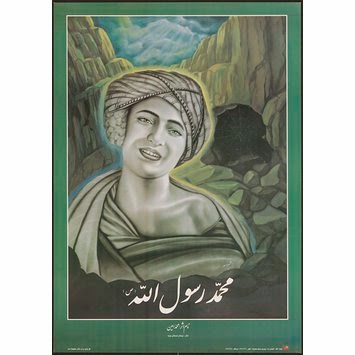
Last Sunday The Independent published a worrying article, entitled: V&A removes depiction of Prophet Mohamed from website amid 'severe security alert'. Uh, what? Just as we are hearing from various experts that early (pre-Wahhab) Islam had no problems about depicting not just human figures but the prophet himself, as for instance in this delightful 16th-century Turkish image of Mohammed welcoming Jacob, from the ‘Zubdet ut Tevarih’ by Lokman (1583):


In fact, anyone who has ever been in the British Museum would have seen Persian and Turkish paintings of Mohammed and various other figures from the Bible and the Koran (they often overlap).

So what's with this picture that has been removed by the Victoria and Albert Museum?
The Victoria & Albert museum has removed a depiction of the Prophet Mohamed from its website amid security concerns just three weeks after the Charlie Hebdo attacks.

The gallery mistakenly claimed not to have had any depictions of the prophet in its collection following the violence by extremists in Paris earlier this month.

But after a US expert drew attention to a poster with an Iranian artist’s view of the prophet in the V&A's collection it was quickly removed.

This has fuelled questions over censorship which scholars fear could undermine our understanding of Islamic art.

“The V&A has one poster in the collection which depicts the Prophet Muhamed," a spokeswoman told The Independent.

“The image of it has been removed from our online database but it remains in our collection and as with most of our reserve collections would be made available to scholars and researchers by appointment.”
All a little incoherent, especially as the image of the poster (not of great artistic value in my opinion but that is not the point) still appears to be there.


On Tuesday Barnaby Rogerson picked up the story in the Spectator and called the rather dubious poster "an historic image of the Prophet Mohammed". Well, it dates back to 1990 so it is historic but it is not one of the old paintings or miniatures and it seems to be easy to find on the website still.

However, Mr Rogerson goes further and enumerates various other examples of self-censorship, exercised by various people who ought to know better.
Last week, an art scholar friend of mine, who is incidentally a Muslim, told me that things are getting worse. He has been doing valuable work for many years, teaching the basic principles of Islamic design to young craftsmen who are keen to reconstruct in carved wood, plaster and painted tile their own Islamic heritage, which has been destroyed by war and revolution. You would have to say that he stands on the side of the angels in this work, for which he is paid only travel expenses. He packs in centuries of artistic development in an accessible three-day or week-long course of lectures, which is also a wonderful testament to his travels and taste, for they are beautifully illustrated by the slides he has taken over the years. You might have thought he would be honoured, but after one of these recent lectures he was arrested by the police of his host-nation and told that he had a choice: either destroy all the slides on his computer or be thrown into jail. His crime was to have shown a beautiful book illustration of the Prophet, veiled in a halo of light, ascending to the heavens.
An unpleasant story, whichever way you look at it but why is the "host-nation" not named? Could the Spectator be exercising its own brand of self-censorship?

This, however, is enormously interesting and gives the lie to the V&A's assertion that it holds not pictures of Mohammed:
We have become so inured to this process that it can be a shock to stroll into a second-hand bookshop and see how free the 1960s and 1970s were from this iconoclasm. To take an example, look at a copy of Emel Esin’s study of the two Holy Cities, entitled Mecca the Blessed, Madinah the Radiant. It is a book that oozes piety, scholarship and devotion, and also has dozens of beautiful illuminated images of the Prophet and his family. If you tried tracking down the various images from the dozen museums proudly cited in the acknowledgements to this book, including lots from the V&A, you would now enter a world of selective silence.
Or, in other words, it is all nonsense about Islam not allowing the depiction of human beings or even of the Prophet Mohammed. It is simply that the more vocal (sadly) section of the huge world-wide Muslim population is going through a violent iconoclastic phase. There is no need for the rest of us to abide by it.

Mr Rogerson's article is well worth reading in full. It is not long.

Thursday, January 29, 2015

Just as you thought politicians could not get any stupider ....

.... along comes this item of information via the Adam Smith Institute blog, which is quoting an article from Monday's Guardian. To be fair to the Grauniad (not words you hear from me often) and its readers, the article makes no comment and merely quotes Scottish Labour MP Thomas Docherty and the readers are shouting his idiocy down.

Mr Docherty has realized that Mein Kampf is not a very nice book and considers that we ought to think of banning it.
Docherty has written to culture secretary Sajid Javid about the text, pointing out that it is currently “rated as an Amazon bestseller” and asking the cabinet member to consider leading a debate on the issue. An edition of Mein Kampf is currently in fifth place on Amazon’s “history of Germany” chart, in fourth place in its “history references” chart, and in 665th place overall.

“Of course Amazon – and indeed any other bookseller – is doing nothing wrong in selling the book. However, I think that there is a compelling case for a national debate on whether there should be limits on the freedom of expression,” writes Docherty to Javid.
Right, let's have a national debate. This blog is weighing in on the side of NO. Or to be a little more detailed, "no, you stupid fool, we cannot ban books, especially those of historic importance, because we do not happen to like what is written in them". Will that do for a debating position Mr Docherty?

If Mr Docherty is worried about anti-Semitism he should think of banning the Koran and, indeed, certain parts of the Bible. The Gospel According to St John springs to mind. He should certainly think about banning certain deeply anti-Semitic publications that his colleagues in the SNP were quoting during the IndyRef campaign.

If Mr Docherty is worried, as he seems to be, that Mein Kampf led to some very nasty events and actions in twentieth century history (not that I believe that as who could possibly have got through that turgid rubbish?) then he had better start thinking about banning Das Kapital, The Communist Manifesto, various works by V. I. Lenin, I. V. Stalin and Mao Zedong. We could start with the Little Red Book, which was most definitely a call for hatred and violence.

Is it really surprising that the book is high on Amazon's list for history of Germany or history references, given its importance? What are students and historians to do in Mr Docherty's ideal society? Sign up, presenting credentials, to the one and only library that will be issuing the book to the right personnel? I do believe we have seen systems like that in certain societies in the twentieth century. Does Mr Docherty want to emulate them? (Maybe I don't want to hear the answer to that.

Sadly, it is against the principles of this blog to call for a ban on stupid pronouncements by politicians though I say this with gritted teeth.

Wednesday, January 7, 2015

It is not senseless - they know what they are doing

The news from Paris is horrific: twelve people killed in an attack on the satirical journal Charlie Hebdo as the journalists had gathered for their editorial conference. I have already seen one British politician expressing his disgust with this "senseless" outrage. Outrage it is, senseless it is not. It is a violent and horrific attempt to silence the media, to stifle free speech. All of us must stand with Charlie Hebdo now and stop wittering about the attack being "senseless".

I have written about that fantastically courageous journal before here, when it was firebombed, and here, when it once again defied the self-appointed spokesmen of a certain religion as well as a few times during my EUReferendum period.

Tuesday, November 4, 2014

Sticks and stones ...

Remember the old saying: Sticks and stones may break my bones but words can never hurt me? How very old-fashioned and outdated of you. Of course, words can hurt you and hurt you so badly that they must be made illegal. That is the way our social and political attitudes are going.

An excellent article by John O'Sullivan of a few days ago outlines the process whereby free speech itself has become an endangered phenomenon in countries that used to pride themselves on it.

Of course, there is a certain amount of exaggeration in descriptions of freedom in the past. Our own libel laws (which Mr O'Sullivan mentions) have made a mockery of the very concept for some decades. Past pressure from politicians on newspaper editors meant that a good many stories were not published though one could argue that some of those stories concerned private rather than public matters. Only some, though. The infamous story [scroll down for mention] of some Labour politicians getting drunk during a foreign trip, uncovered by a journalist whose career was then destroyed because said MPs thought nothing of suing for libel and lying on oath did concern public matters. Thereafter journalists became very cautious, indeed, about their stories.

Setting that and many other examples aside, we have to admit that the notion of people being so hurt by words whether in print, on the media or on the internet that those words must not be allowed to be said is a situation that none of us can be happy with. Or can we?

After all, people who shout loudly off about "political correctness" will also demand that the burning of poppies be banned as if that were the equivalent of a genuine attack on a poppy seller. It isn't. It is nasty and unpleasant but once we start banning nasty and unpleasant we are moving towards censorship and authoritarianism.

Back in the seventeenth century John Milton had the answer to it; back in the nineteenth century John Stuart Mill had the answer to it. Unless the question is of violence or any direct harm to the individual or the state (the only religious denomination Milton refused to allow was the Roman Catholic because they were conspiring against the state) then, unpleasant though those words and actions are, we have to allow them. For who decides what is unpleasant and even nasty? The police? Some organization set up for the purpose? Public opinion on a particular day?

Meanwhile, John O'Sullivan's article is well worth reading.

Thursday, October 23, 2014

Fun and games with UKIP

[Health warning: yes, this is another posting about UKIP but it is not entirely critical of that benighted organization or, at least, it is hightly critical of those who have attacked it recently. UKIP-bots take note.]

UKIP have managed to get themselves into the news again on two accounts, neither of which has anything to do with their policies (and that might be just as well). Both stories have caused a great deal of indignation and a certain amount of amusements. I plead guilty to the second attitude.

The first story, as British readers of this blog probably know, is about that ridiculous calypso that was written by former BBC DJ Mike Read (no, I've never heard of him before this either) and performed with a mock-Caribbean accents at some fringe event, went on YouTube and was attacked as being racist. At first, Read said that he considered the accusations preposterous and the Dear Leader called on the faithful to get the calypso to No 1 in the pop charts.

After that things became a little difficult. For one thing the words of the song were published and turned out to be astonishingly stupid. For another, people who are not completely obsessed with UKIP either pro or con (I expect I shall be accused of being one of those by some UKIP-bots but I do not think the amount of time I have spent on them over the years of writing this blog or being co-editor of EURef warrants that accusation), wondered why they should have picked on the calypso as a particularly cool, up-to-date and funky kind of music.

As it happens, I have a much loved LP (or vinyl as they are called now, having become rather fashionable again) of Harry Belafonte singing calypsos in a mock Caribbean accent, Belafonte's own accent being pure American. So far as I know there were no problems with that but I don't know for sure. The LP (vinyl) was inherited by me from my father who acquired it in the 1950s, possibly on one of his two trips to London from Budapest where we lived at the time. Does that throw any light on the strange UKIP decision? Well, yes, I think it does. This is all part and parcel of their nostalgia for that rather unpleasant decade.

The faux-outrage over the racism of the song has achieved its aim and former DJ Mike Read "has apologised for his Ukip-supporting calypso song and asked for it to be withdrawn from sale following criticism that it was racist". Stupid the idea may have been but the idea that somebody must always apologize and something must always be suppressed if anybody is offended and, particularly, if the word racist can be bandied round, is turning British politics into a specie of blancmange.

The story is not over.
Read’s song just failed to make the top 20 in the midweek rundown of the official singles chart, debuting at number 21 according to the list published on Wednesday. A spokesman said sales of the song to date would continue to contribute to the official top 40, despite Read’s decision to withdraw it.

It could mean another dilemma for the BBC over whether to include the song in its official top 40 programme on Radio 1 on Sunday, in a potential echo of the row over the anti-Thatcher protest song, Ding-Dong! The Witch is Dead.
That, of course, was not withdrawn from sale as it was not racist and offended only in the matter of good taste. But it did not get to No 1 either.

Here, by the way, is UKIP's Culture Spokesman, Peter Whittle, attacking the attackers. It is not clear whether he actually liked the song but his political point is a very reasonable one. [Full disclosure: Peter is a good friend.] I would say that the faux outrage has not exactly harmed UKIP while an understanding of the silliness would have done. As it is, they can proclaim that they are victims of the modern mania for censorship of anything that can be described as racist.

Let us now turn to the other story, that of their new ally in the European Parliament. The Toy Parliament does not run on the basis of parties but groups and there are rules about how many parties and countries have to be represented in each group in order to be able to claim the handsome hand-outs for the MEPs' entertainment hard work. For a while it looked like Nigel Farage had managed to put his Europe of Freedom and Direct Democracy (EFDD)group together (no, I don't know what that title means either but they had to think of something and the others are not much better). Then potential disaster struck: the Latvian MEP Iveta Grigule (more here) decided to leave the group, thus making it untenable in Toy Parliament terms.

As ever, we heard accusations and counter-accusations. Nigel Farage "has accused the president of the European parliament, Martin Schulz, of "effectively blackmailing" Grigule by offering her the leadership of an overseas delegation in a deliberate attempt to silence Ukip and the eurosceptic EFDD".

Ms Grigule retaliated by saying that if she had been susceptible to "blackmail" she would have taken Mr Farage up on his offer of the group's Vice-Presidency and, anyway, she had already managed to fall out with the Dear Leader over his working methods that she characterized as being rude. Nor was she impressed by the rest of the UKIP MEPs.
"In July this year I already suggested to Nigel Farage that he should change his working style. The fact that he did not take my suggestion into account this whole time is not right," she said.

"I do not find it acceptable that MEP’s turn their backs on the European anthem or the flags of member states. I do not find shouting or rude remarks acceptable during plenary sessions, or that the majority of colleagues from Great Britain do not take part in the work of committees. I warned Farage, that if nothing changes in this attitude, I will leave the group.

"Of course, this style of working may be beneficial to Farage as his popularity in Britain grows, but to other group delegations this isolationism from the other Parliamentary groups disrupts the ability to work. This was a road leading to nowhere."
The only thing I can add to that story is that it would seem that neither Mr Farage nor Ms Grigule know the difference in meaning between blackmail and bribery.

As it happens, there are always odd MEPs hanging around the Toy Parliament who can be bribed or blackmailed, depending on your use of the English language, to join a group and the Dear Leader found one: he is the Polish MEP Robert Iwaszkiewicz (more here) of the Congress of the New Right and a man who has distinguished himself by being a Holocaust denier and a supporter of domestic violence. Not a particularly prepossessing chap and neither is his party.
Korwin-Mikke [the party's leader], whose party has two remaining MEPs and received 7.5% support in Poland during May’s European parliamentary elections, is one of the most outspoken figures within the far-right groupings of parliament.

In July, he declared in English that the minimum wage should be “destroyed” and said that “four million niggers” lost their jobs in the US as a result of President John F Kennedy signing a bill on the minimum wage in 1961. He went on to claim that 20 million young Europeans were being treated as “negroes” as a result of the minimum wage. He refused to apologise and was fined 10 days of allowances for his comments.

Korwin-Mikke has also called for the vote to be taken away from women, has claimed that the difference between rape and consensual sex is “very subtle” and said that Adolf Hitler was “probably not aware that Jews were being exterminated”.
Of course, saying that Hitler was not aware that Jews were being exterminated, stupid though that is, does not constitute Holocaust denials but we can say with some certainty that the Polish party, its members and its leader are not people one wants to have much to do with partly because of their opinions and, even more, because of their level of intelligence.

The problem is that as long as we are in the EU and send members to the Toy Parliament (on a very low vote, it is true) we have to deal with people like Mr Iwaszkiewicz and Mr Korwin-Mikke, as well as people who either deny the extent of Communist crimes or consider the gulags to have been quite a good idea. We do not elect these people but others do.

The outrage over a perfectly ordinary if slightly shoddy political transaction has been deafening. I have even seen demands that UKIP should be banned in Britain. A party that has received a fair number of votes should be banned, I asked. That is your democratic suggestion? I got a lot of huffing and puffing in return and reminders that the British Union of Fascists was banned and Sinn Fein was kept off the airwaves for some years. The BUF was banned durign the war, I replied, as they were seen with some (though not total) justification as aiding and abetting the enemy. Incidentally, I added, the CPGB that was doing the same between the autumn of 1939 and June 22, 1941, actively inciting members of the armed forces to desert, was not banned. And Sinn Fein was not actually banned, merely not allowed to speak on air because they were and are closely linked to a terrorist organization, the IRA. UKIP has merely done something many of us find distasteful. It is not illegal and it cannot be described as aiding and abetting the enemy. Should all those British parties who sit in groups with well known members of Communist parties be banned? There was more huffing and puffing and, in one case, a highly ironic denial that anybody denies the gulags. There was no reference to the victims of collectivization.

But I digress.

Will the second story help UKIP? Not as much as the first one, as Mr Iwaszkiewicz, the latest addition to the EFDD group is rather unsavoury and a good many UKIPers, not to mention their supporters and quasi-supporters are embarrassed by the story. Does it matter electorally? Probably not. I have no doubt the story will be rehashed during the electoral campaign next year but there are plenty of embarrassments to be brought up against all parties in the Toy Parliament. The truth is that the overwhelming majority in this country does not care about that institution.

A far more serious story is the one produced by the Evening Standard yesterday:
Britons have turned against the idea of quitting the European Union despite the rise of Ukip, exclusive new polling reveals today.

It found that a clear majority would vote to stay in the EU in a referendum — marking a dramatic turnaround from two years ago. The findings suggest Ukip’s surge this year has less to do with anti-EU sentiment and more to do with anxieties about immigration or disenchantment with the bigger parties.

Fifty-six per cent of people said they would vote to stay in if there were a re-ferendum now, while just 36 per cent would vote to leave, according to the Ipsos MORI poll. Excluding “don’t knows”, that amounts to a clear divide of 61 to 39 per cent.

In November 2012, the same question found that 44 per cent wanted to stay and 48 wanted to get out. At the time, support for Nigel Farage’s party stood at a mere three per cent, compared with the current level of 16 per cent — a record figure for an Ipsos MORI poll. But while support for Ukip has risen by 13 percentage points over the two-year period, support for quitting the EU has dropped by 12 points.

Backing for EU membership is at its highest since 1991 — before the Maastricht Treaty which increased integration and created the European Union out of the European Community.
The turn-around is not as dramatic as all that and is probably temporary. Opinion on the subject tends to be volatile but it has never reached the sort of support for Brexit that would indicate a victory in the referendum. Whether that is despite or because of the rise of UKIP is arguable. This blog has argued for some time that the present-day UKIP is a hindrance to the cause of British exit. It has certainly not been a help.

Another conclusion that ought to be drawn but probably will not be by people obsessed with the idea of a referendum is that we are certain to lose it and should turn our attention more widely (yes, I know the Boss has been working on it) to the question of how we can win it, should it ever come about.

Wednesday, May 21, 2014

The Politkovskaya saga goes on

Five people, three of whom were found not guilty in 2009, have now been found guilty of the murder of the journalist Anna Politkovskaya. I have written about the case, most recently here about the arrest of Lt-Col. Pavlyuchenkov, here about the muddled developments and here about the sentencing of Dmitri Pavlyuchenkov to 11 years for his role in the assassination though, thanks to a plea bargaining he had not had to give evidence at his trial, thus leaving the question of who actually ordered the murder wide open.

So now we have the brothers Makhmudov, their uncle and another retired policeman guilty of the murder and waiting to be sentenced tomorrow. In 2009 the three brothers had been found innocent but the verdict was overturned by the supreme court and they were tried again. Presumably, had they not been found guilty this time they would have been tried again and again.

There are a few oddities in the case as anyone who has followed it even superficially can attest, not least the question as to who are these Chechnyans who assassinated the journalist who had written articles that were strongly critical of the Russian government and the Russian troops' behaviour in Chechnya and surrounding republics?

Nor has the vital question of who was behind the murder been solved.
A committee set up to investigate the shooting said it was still looking for the person who ordered the operation.
Naturally, nobody can think of a possible answer to that question.